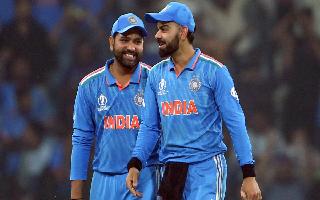
The Ajit Agarkar-led selection committee faces a challenging task in choosing the T20 squad for the series against Afghanistan, as veterans Rohit Sharma and Virat Kohli express their eagerness to participate in the upcoming T20 World Cup in June. Both players have not featured in the shortest format for India since the T20 World Cup semifinal against England in November 2022.
As per a report in PTI, "Selectors Shiv Sunder Das and Salil Ankola, along with chairman Agarkar, are expected to consult with head coach Rahul Dravid, Test, and ODI captain Rohit, and star batter Kohli during the ongoing second Test at Newlands before finalizing the squad for the series against Afghanistan starting on January 11 in Mohali."
With an eye on the ICC event in the Caribbean and the United States, around 30 T20 specialists, including Indian and IPL stars, will be closely monitored. The dilemma lies in whether to include Rohit and Kohli directly for the Afghanistan series or assess their form and fitness during the IPL.
“Suryakumar Yadav and Hardik Pandya aren't fit. The Afghanistan series won't tell you anything. Everything will be decided on the basis of the first month of IPL,” a senior BCCI source was quoted as saying by PTI.
The duo has expressed their keenness to be part of the T20 World Cup, and although England Tests commence on January 25 in Hyderabad, the likelihood of them playing beyond a couple of matches, if selected, remains low.
Also Read: Jemimah reflects upon 3-0 loss against Australia
The BCCI acknowledges the challenge of instructing franchises on the optimal usage of potential T20 World Cup picks, considering the IPL concludes in late May, just before the global tournament. As a result, around 25 to 30 players are expected to be closely monitored during the IPL, allowing for flexibility in case of injuries or fitness concerns.
“The BCCI can never tell a franchise to manage a star player's workload unless it's a case of injury management,” source added.
However, Mumbai Indians skipper Hardik Pandya poses a unique situation, as his like-for-like replacement may not be readily available.
Inputs from PTI