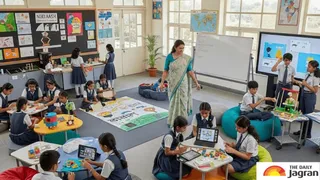
Digital Transformation In Education: Across India, classrooms are changing in ways that go beyond replacing blackboards with screens. The transformation reflects a broader shift in how learning is designed and experienced. For decades, education followed a fixed model centred on lectures, textbooks, and memorisation. While that approach remains relevant, it is steadily evolving towards methods that are more flexible, inclusive, and responsive to learners' needs.
According to Monica Malhotra Kandhari, Managing Director, AASOKA by MBD Group, this transition is being driven by greater digital access, changing student expectations, and policy initiatives such as the National Education Policy (NEP) 2020 and the National Curriculum Framework 2022–23. Together, these developments are helping position education as a true equaliser, giving importance to competencies and participation alongside traditional measures of success.
Is the Physical Classroom Still Enough?
The idea of a classroom is gradually expanding. She notes that learning is no longer limited to a single location or fixed schedule. Alongside conventional classrooms, digital platforms allow students to continue learning beyond school hours.
Recorded sessions, digital resources, and interactive content enable students to revisit lessons, strengthen their understanding, and learn at their own pace. This flexibility allows learners to engage with concepts more effectively. A major driver of this change is the growth of digital access. India now has 958 million active internet users, with rural India accounting for 57 per cent of this base, approximately 548 million users. As connectivity becomes more affordable, learning opportunities are becoming increasingly accessible across geographies.
Can Blended Learning Find the Right Balance?
One of the most significant shifts, according to Kandhari, has been the rise of blended learning, where digital tools complement rather than replace traditional teaching. Classroom instruction remains central, while technology provides additional ways to engage with concepts.
Features such as gamification, virtual labs, educational videos, and collaborative platforms are making learning more engaging. Simulations, quizzes, and project-based activities encourage active participation while helping students develop communication and problem-solving skills. Teachers continue to play a crucial role by guiding students and facilitating learning. In a country like India, where classrooms often vary in terms of access and learning levels, blended learning offers flexibility without compromising educational quality.
Is Access to Quality Education Finally Opening Up?
Access to learning resources has long been uneven, but that gap is beginning to narrow. Efforts are also being made to support students without reliable internet access. One such approach highlighted by Kandhari is the use of television, with educational content being broadcast across multiple channels, enabling students to continue learning regardless of connectivity challenges.
Technology is also helping address another longstanding challenge: recognising that students learn differently. Digital platforms can identify learning gaps and mastered skills, enabling a more personalised educational experience. In diverse Indian classrooms, this can reduce pressure on students to progress at the same pace and support better learning outcomes.
How Is AI Playing A Supporting Role In Education?
Artificial intelligence is gradually finding its place within education by supporting learning processes. As Kandhari explains, AI can help assess student progress, provide targeted feedback, personalise content, and automate routine tasks such as grading and performance tracking, allowing educators to focus more on student engagement.
Reflecting this growing importance, the Union Budget 2026–27 proposed a high-powered 'Education to Employment and Enterprise' Standing Committee to examine the impact of emerging technologies, including AI, on jobs and evolving skill requirements. As AI becomes more integrated into education, issues such as accessibility, data confidentiality, and fairness must be addressed to ensure its benefits are inclusive.
Where Is the Future f Learning Headed?
The shift to technology-based learning is still evolving. Challenges related to infrastructure, device accessibility, and teacher training remain important. However, the direction is clear. The Indian edtech sector is projected to reach Rs 2,50,850 crore by 2030, highlighting technology's growing role in education.
More importantly, as Kandhari concludes, classrooms are becoming more interactive, flexible, and aligned with how students engage with the world around them. Technology alone will not define the future of learning. Its true value lies in how it is combined with strong pedagogy, personal interaction, and an understanding of diverse learners to create deeper and more meaningful learning experiences.