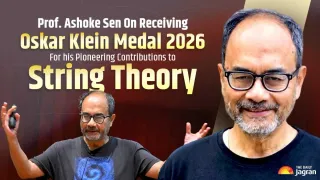
Oskar Klein Medal 2026: Renowned Indian theoretical physicist Professor Ashoke Sen has been awarded the 2026 Oskar Klein Medal, becoming the first Indian physicist to receive this international honour. Previous recipients include Stephen Hawking, Peter Higgs and Kip Thorne, placing him among the biggest names in physics.
Sen received the medal and delivered a lecture titled “Gravity from strings and strings from gravity” at the AlbaNova University Centre in Stockholm on October 22. He explained how string theory can describe gravity using quantum physics and help answer questions about black holes.
Ashoke Sen’s Key Research
Particulars | Details |
Field | Theoretical physics, string theory |
Key Contributions | String theory, black hole entropy, string field theory |
Major Finding | Helped show five string theories may be different descriptions of one theory |
Other Honour | Breakthrough Prize in Fundamental Physics (2012) |
Padma Awards | Padma Shri (2001), Padma Bhushan (2013) |
Current Position | Infosys-Madhava Chair Professor, ICTS Bengaluru |
What His Research Showed
String theory proposes that the basic building blocks of matter are tiny strings rather than point-like particles, with different vibrations appearing as different particles. Sen helped show how a theory describing strong interactions can be equivalent to another describing weak interactions.
Other scientists built on this work to connect the five string theories. According to Sen, the main challenge is finding a solution within string theory that matches the particles observed in nature.
Professor Ashoke Sen Academic and Career Journey:
Sen studied at Presidency College in Kolkata and the University of Calcutta. He was drawn to mathematics at school, and his father taught physics at a college. One of his teachers was physicist Amal Kumar Raychaudhuri.
After post-doctoral research in the United States, he returned to India and spent many years at the Harish-Chandra Research Institute in Prayagraj, where he developed much of his string theory work. He now serves at the International Centre for Theoretical Sciences in Bengaluru.
Reaction and Outlook
ICTS Director Rajesh Gopakumar congratulated Sen, saying it has been wonderful having him at the institute and that he sets the tone for excellence. Sen has noted that string theory may not be verified in our lifetime, yet he continues to work on ideas that may take decades to test.
What Is the Oskar Klein Medal?
The Oskar Klein Medal was established in 1988 and is named after Swedish theoretical physicist Oskar Klein. It is awarded annually by Stockholm University and the Nobel Committee for Physics of the Royal Swedish Academy of Sciences. The medal honours distinguished contributions to physics. Past recipients include Nobel laureates Stephen Hawking, Peter Higgs, Chen-Ning Yang, Steven Weinberg and Hans Bethe, which underlines the award’s international standing.