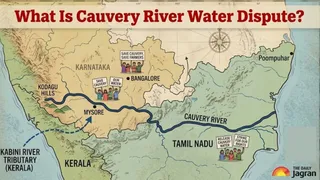
Cauvery River Water Dispute: The decades-old Cauvery water dispute has entered another flashpoint, with the Tamil Nadu government moving the Supreme Court against Karnataka for allegedly failing to release the state's due share of river water despite clear directions from the Cauvery Water Management Authority (CWMA) and the Cauvery Water Regulation Committee (CWRC), according to the Tamil Nadu government. Chief Minister C. Joseph Vijay directed officials to approach the apex court after Karnataka allegedly ignored repeated orders to release water.
Today, we bring you a detailed discussion about this Cauvery river water dispute among Tamil Nadu, Karnataka, and Kerala, covering why it has resurfaced now, the institutions involved, and the long history behind one of India's most persistent inter-state river disputes.
Why Is This In The News?
The Cauvery Water Management Authority (CWMA) endorsed the Cauvery Water Regulation Committee (CWRC) order directing Karnataka to release 3,500 cusecs [around 4.5 tmc ft (Thousand Million Cubic feet)] of water to Tamil Nadu, despite a 60 per cent shortfall in reservoir inflows.
Karnataka opposed the order, arguing that irrigation has not yet commenced due to inadequate rainfall, while Tamil Nadu considered the allocated quantity insufficient and demanded the release of 9.8 tmc ft, reigniting the long-standing inter-state river water dispute amid deficient monsoon rainfall.
Simultaneously, Tamil Nadu has opposed Karnataka's proposed Mekedatu Balancing Reservoir Project, urging the Prime Minister to withhold statutory and administrative approvals.
Cauvery River Water Dispute Timeline
Year/Period | Key Development |
1892 & 1924 | Dispute originates from agreements between the Princely State of Mysore (Currently Karnataka) and the Madras Presidency (Currently Tamil Nadu, Andhra Pradesh, Karnataka, and Kerala) |
Post-Independence | Conflict brought under Article 262 and the Inter-State River Water Disputes Act, 1956 |
1990 | Cauvery Water Disputes Tribunal (CWDT) constituted to resolve the dispute |
2007 | CWDT Award allocates 740 TMC of Cauvery water- Tamil Nadu: 419 TMC, Karnataka: 270 TMC, Kerala: 30 TMC, Puducherry: 7 TMC, Environmental purposes: 14 TMC |
2018 | Supreme Court modifies the Tribunal's award, granting Karnataka an additional 14.75 TMC (Tamil Nadu's share reduced to 404.25 TMC, Karnataka's increased to 284.75 TMC), citing Tamil Nadu's groundwater availability and Bengaluru's drinking water needs |
2018 (Ruling) | SC holds that inter-state rivers are national assets and no state has exclusive ownership |
2018 (Directive) | SC directs establishment of the Cauvery Water Management Authority (CWMA) and Cauvery Water Regulation Committee (CWRC) to implement the water-sharing arrangement and manage distress years |
ALSO READ: NEET UG 2026 Row: Six Students Move SC Over Alleged Discrepancies In OMR Sheets
What Is The Cauvery Water Management Authority (CWMA)?
The CWMA was constituted by the Central Government in 2018 under the Cauvery Water Management Scheme, 2018, along with the Cauvery Water Regulation Committee (CWRC).
It is a statutory, quasi-judicial body notified under the Inter-State River Water Disputes Act, 1956, to implement the modified Cauvery Water Disputes Tribunal (CWDT) Award as upheld by the 2018 Supreme Court judgment.
Headquartered in New Delhi under the Ministry of Jal Shakti, it is chaired by a Secretary/Additional Secretary-rank IAS officer or senior engineer, and comprises full-time and part-time members representing Karnataka, Tamil Nadu, Kerala, and Puducherry.
Its key functions include regulating inter-state water releases, determining distress-sharing during deficient rainfall years, and monitoring reservoir storage and outflows.
What Are The Key Facts About The Cauvery River?
Known as the "Ganga of the South," the Cauvery is a major east-flowing peninsular river and one of India's longest-running inter-state water disputes. It originates at Talakaveri in the Brahmagiri Hills (Kodagu, Karnataka) and flows through Karnataka and Tamil Nadu before draining into the Bay of Bengal near Poompuhar, covering a drainage basin of about 81,155 sq. km across Karnataka, Tamil Nadu, Kerala, and Puducherry.
Its major dams include the Krishna Raja Sagara in Karnataka and the Mettur Dam in Tamil Nadu, while protected areas in the basin include Nagarhole National Park, Wayanad Wildlife Sanctuary, and Sathyamangalam Tiger Reserve.
What Is The Mekedatu Project Row?
The Mekedatu Project is a proposed 48 TMC balancing reservoir on the Cauvery River at Mekedatu in Karnataka's Ramanagara district, about 100 km south of Bengaluru.
Its objectives are to provide drinking water to Bengaluru, recharge groundwater, and generate hydropower, with Karnataka maintaining that the project will not alter existing water allocations.
However, Tamil Nadu argues that increased upstream storage could enable Karnataka to regulate river flows during distress years, affecting downstream releases and Cauvery delta agriculture, citing the CWDT Award's restriction on upstream projects without mutual agreement and consultation with the regulatory authority.