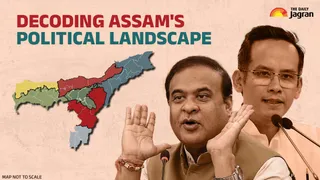
Assam Elections 2026: The stage is set for the voting in the Assam Assembly elections 2026 on April 9. The Election Commission (EC) said that it is fully prepared to conduct polling in the northeastern state in a free, fair, and peaceful manner, with voting across all 126 assembly constituencies. The ruling Bharatiya Janata Party (BJP), led by Chief Minister Himanta Biswa Sarma, is seeking its record third term, while Gaurav Gogoi-led Congress is hopeful to end the 10-year-long drought. Assam's political landscape is complex and cannot be seen in black and white. With a presence of around 40 per cent Muslim population and divided Hindu sections, it is not easy to decode people's mood.
A total of 722 candidates, including Chief Minister Himanta Biswa Sarma, state Congress president Gaurav Gogoi, Leader of Opposition Debabrata Saikia, AIUDF chief Badruddin Ajmal, Raijor Dal leader Akhil Gogoi, and AJP president Lurinjyoti Gogoi, are in the fray.
Among political parties, the Congress has fielded the highest number of candidates at 99, followed by the BJP with 90. The AIUDF has 30 candidates, while NDA constituents Asom Gana Parishad (AGP) and Bodoland People's Front (BPF) are contesting 26 and 11 seats, respectively. In the opposition bloc, Raijor Dal is contesting 13 seats, Assam Jatiya Parishad (AJP) 10, CPI(M) 3 and APHLC 2.
We can divide Assam into seven prime regions, which have their unique political nature, to understand the political landscape:
BTC Region: Despite the BPF's recent landslide win in the Bodoland Territorial Council polls, the political landscape in this western Assam belt appears fluid ahead of the assembly elections, with no clear frontrunner, even as the NDA seeks to leverage its tie-up with the Bodoland People's Front across 15 seats. The BJP-led alliance enters the fray with a perceived edge, banking on its renewed partnership with the regionally dominant BPF, but local dynamics and the entrenched influence of regional players like the United People's Party Liberal (UPPL) continue to keep the contest open.
ALSO READ: Assam Elections 2026: PM Modi Targets Congress At Hojai Rally, Says 'Its Slogan Is Family First'
North Assam: North Assam or North Bank of Brahmaputra, spread through Sonitpur, Darrang, Biswanath, and Udalguri, is a strategically important region in state politics, with a stronghold of NDA. In the 2021 Assembly elections, the NDA bagged 11 out of 15 seats in the region. BPF, an ally of the BJP, also holds influence in the Bodo-influenced areas.
Upper Assam: Upper Assam, a tea-oil belt around Tinsukia, Sivasagar, Jorhat, Golaghat, Charaideo, Lakhimpur, Dhemaji, Majuli and Biswanath, has a strong influence from tea garden workers, oil industry areas, and traditional BJP-AGP strongholds. Tea tribes, Ahom communities, and urban pockets are key voter sections that elect around 50 MLAs to the assembly.
Central Assam: Central Assam is a critical political swing region. Previously, it was a Congress stronghold, but now it favours the NDA. The region, spread through Nagaon, Morigaon, and Hojai, elects around 20 MLAs.
ALSO READ: 'Lying For Long': Gaurav Gogoi Slams Assam CM Sarma Over Pakistan Link Allegations
Hill Region: The Assam hill region, which is governed by autonomous councils under the Sixth Schedule of the Indian Constitution, spreads across Dima Hasao, Karbi Anglong, and West Karbi Anglong. The region sends 6 MLAs to the state assembly.
Barak Valley: Barak Valley, a diverse and politically sensitive region due to the presence of Bangali-speaking Muslim population, encompasses the districts of Cachar, Sribhumi (Karimganj), and Hailakandi. After the 2023 delimitation, the number of seats was reduced from 15 to 13, which gives an advantage to the ruling establishment.
Lower Assam: Lower Assam consists of 12 districts: Dhubri, South Salmara-Mankachar, Kokrajhar, Chirang, Bongaigaon, Goalpara, Barpeta, Bajali, Nalbari, Baksa, Kamrup, and Kamrup Metropolitan. It is a key area where the Muslims are in the majority. It is a stronghold of Badruddin Ajmal's AIUDF and Congress.
(With Agencies inputs)