The Union Budget 2026, to be presented today, is expected to break away from long-standing traditions followed since Independence. Finance Minister Nirmala Sitharaman is likely to use Part B of her Budget speech to outline a comprehensive roadmap for India’s economic future, marking a major shift in the 75-year-old budgeting framework.
As reported by NDTV, Part B will no longer be limited to tax proposals and incremental policy changes. Instead, it is expected to offer a holistic view of India’s economic direction, clearly spelling out both short-term priorities and long-term strategies, an approach seen as significant for economists and financial markets alike.
Traditionally, Part A of the Budget speech carried the most significant announcements, including development initiatives, infrastructure plans, and major policy targets, while Part B was largely confined to direct and indirect tax proposals and limited policy measures. This year, however, that structure is set to change.
In a major departure from convention, Part B will now outline both short-term priorities and long-term objectives. As India moves deeper into the 21st century, the speech is expected to emphasise the country’s domestic strengths alongside its global ambitions.
A significant shift in the Budget speech
This change is being closely watched as economists and investors will focus not only on tax rates or relief measures, but on the broader economic roadmap. According to reports, Part B will present a detailed assessment of India’s current capabilities, internal strengths, and future growth potential.
The shift reflects the government’s vision of positioning India as a stronger player on the global stage. Markets have responded with optimism, as the move is expected to provide greater clarity on the economy’s long-term direction.
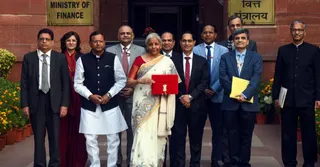
Finance Minister Nirmala Sitharaman is presenting her ninth consecutive Union Budget. In her first Budget in 2019, she broke with tradition by replacing the leather briefcase with a red cloth-bound ledger. For the past four years, the Budget has been presented in a completely paperless format on a tablet, a practice that will continue this year.
Capital expenditure in focus
The government has met its fiscal discipline goal by keeping the deficit below 4.5 per cent of GDP in fiscal 2026. Attention has now shifted to reducing the debt-to-GDP ratio in fiscal 2027. Whether the government provides a clear fiscal deficit target for the next financial year will be a key point to watch.
Capital expenditure for the current fiscal year was pegged at ₹11.2 lakh crore. With private sector investment still cautious, the government is expected to maintain its capex-led growth strategy. The upcoming Budget is likely to announce a 10–15 per cent increase in capital spending to boost infrastructure and economic momentum.
GDP growth, inflation, and key schemes
The Budget will also present estimates for nominal GDP growth in fiscal 2027, offering clues about inflation trends. Several projections suggest the government may peg nominal GDP growth between 10.5 and 11 per cent.
ALSO READ: Budget 2026: Part B Of Budget In Focus; What Is It And Why Is It Important?
Spending on major schemes such as the PM Gram Sadak Yojana (GRAMS), along with allocations for health and education, will be closely monitored. The government is expected to strike a balance between rural and urban development by increasing investments across these critical sectors.