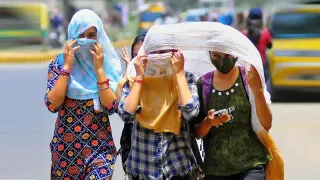
Delhi Weather: As the heatwave conditions continue to intensify, the Delhiites on Sunday woke up to a "feel-like" temperature touching nearly 42 degrees Celsius at around 9 am. We often see these notifications on our weather apps, displaying a "feels-like" that is usually higher than the actual temperatures. According to IMD's daily weather bulletin, Delhi's actual maximum temperatures are expected to settle between 39 and 41 degrees Celsius. So, why does the feel-like temperature always stand higher than the actual temperature? Here's the science behind the difference.
As per the Met Office, a "feels like" temperature (or apparent temperature) is the perceived human sensation of air temperature, calculated using a combination of actual air temperature, relative humidity, and wind speed. It gives a more accurate idea of how the weather will feel on your body than the actual air temperature alone. To put it more simply, the temperature data by the IMD reflects the temperature of the city air measured under standard conditions, while going out exposed surfaces like roads, concrete, and vehicles become substantially hotter than the air around them; this is the "feels like" temperature.
The human body absorbs high surface temperatures even more through radiation and gradually makes urban areas hotter than the official temperature, compared to rural areas.
BBC reported that a Greenpeace researcher Nibedita Saha went to the IIT flyover, one of the busiest areas of the city. As she spanned her camera from the shaded areas under the flyover (where the reading was 42C) to the bikers idling at stop signals under the direct sunlight, the reading went up to 64C. The surface temperature of the spot where we stood was 61°C—it fell to 39.8 degrees Celsius when we moved less than 10 ft away to stand under a tree.
"Consistent exposure to such high temperatures can cause major health issues," BBC quoted Nivedita as saying. "We got instant relief. That's the difference just one tree can make," she added.
According to the IMD, the heat index, or “feels-like” temperature, touched 48.4 degrees Celsius and is expected to remain significantly above the actual air temperature during the afternoon hours. The IMD has also warned of heatwave conditions in some areas of Delhi on June 28.
Why Is Feels-Like Temperature Intensifying?
According to Mahesh Palawat, vice president of Skymet Weather, the southwesterly winds from the Arabian Sea, which are currently feeding moisture over Pakistan and northwestern India, are increasing the humidity level. The ‘feels-like’ temperature is high due to this increased humidity, combined with the high temperature. The monsoon is also not close, as, if it were, winds would be approaching from the Bay of Bengal, which we are currently not seeing. So the ‘feels-like’ temperature is likely to remain high over the coming few days."
How Bad Is The 'Wet-Bulb' Temperature?
Experts also pointed to elevated wet-bulb temperatures, which reached 29.77 degrees Celsius at 2.30 pm and 28.09 degrees Celsius at 5.30 pm.
A wet-bulb temperature of 32°C or more makes prolonged outdoor work difficult even for healthy and adjustable people. At 35 degrees Celsius, the highest value on the scale, the human body can no longer regulate its temperature, increasing the risk of heat stroke and collapse.
The weather department has also forecast rain accompanied by thunderstorms and strong winds from Monday to Friday. A yellow alert has been issued for Tuesday and Wednesday.