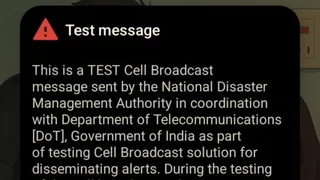
Have you recently received a loud, vibrating "TEST" message on your mobile phone? I received it today, If you also received it, there is no need to panic. These notifications are being dispatched by the Department of Telecommunication (DoT) in collaboration with the National Disaster Management Authority (NDMA).
Why We Are Getting This Alert?
The primary objective is to evaluate the Cell Broadcast alert system to ensure it functions effectively during real emergencies. As noted in the notification itself, these messages may appear multiple times on your device and should be ignored once acknowledged.
The Evolution Of India’s Alert Infrastructure
The NDMA has successfully launched the Integrated Alert System, known as SACHET in 2025. Developed by the Centre for Development of Telematics (C-DOT), this platform utilises the Common Alerting Protocol (CAP) as recommended by the International Telecommunication Union (ITU).
ALSO READ: SC dismisses plea seeking to restrain construction of mosque in name of Babri Masjid in Murshidabad
Across all 36 States and Union Territories, the system had delivered geo-targeted emergency warnings via SMS. To date, disaster management authorities have utilised this infrastructure to send over 6,899 crore SMS alerts in 19 Indian languages.
Why Shift From SMS To Cell Broadcast?
While SMS alerts are effective, time-critical disasters such as tsunamis, earthquakes, or chemical leaks require near-instantaneous communication. Cell Broadcast (CB) technology offers a significant advantage over traditional SMS:
Real-Time Delivery: Alerts are broadcasted to every mobile phone in a specific geographical area simultaneously.
Network Efficiency: Unlike SMS, which can get delayed during network congestion, Cell Broadcast bypasses traffic to ensure immediate delivery.
Indigenous Development: C-DOT, the research and development arm of the Department of Telecom, is spearheading the indigenous creation and implementation of this public emergency system.
Citizens across the country may receive test alerts in both Hindi and English. These messages are purely for technical verification and do not signify an actual emergency.