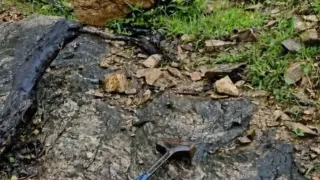
Chhattisgarh: An approximately 3.65 billion-year-old rock fragment has been discovered in the forests of Chhattisgarh's Bastar, making it the oldest known rock in India. As per the reports, this rock belongs to the period when Earth was cooling and forming its first crust. The discovery is being considered a landmark, as the age of India's geological history will now be around 150 million years older.
Pushes Back Geological History
The discovery is part of a study to be published in the journal Geoscience Frontiers and has pushed India's surviving rock record back by about 150 million years. The latest discovery has now surpassed Singhbhum in Jharkhand, which had held the top spot in terms of antiquity for decades. Earlier, the research in Bastar had estimated the age of the certain rocks to be about 3.56 billion years old.
The significant discovery has been made along the Bhopalpatnam-Bijapur corridor, where a craton is still located surviving centuries of collision, compression, and melting. The study was conducted by Professors Pritam Nasipuri and Kaushik Satpathy of the Indian Institute of Science Education and Research (IISER), Bhopal.
Three Major Events Revealed
Apart from this, contributions were also made by Professor Kewuk Yi of the Korea Basic Science Institute and Abhijit Bhattacharya, a former professor at IIT Kharagpur. The study's analysis highlights three major events in the region's early history- the first occurred around 3.65 billion years ago, the second between 3.64 and 3.60 billion years ago, and the third reconstructed between 3.44 and 3.40 billion years ago.
The research team identified two distinct rock types, the oldest of which is gneiss, or striated rock. While providing details, Professor Nasipuri stated that the stripes reflect its long and complex geological history. He further stated that it was formed by heating and partial melting deep in the crust, perhaps 30 to 50 km below the surface.