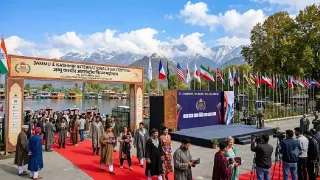
Jagran Correspondent, Srinagar: Jammu and Kashmir's first International Film Festival may have begun with big promises of global cinema, cultural exchange and an international platform for filmmakers, but for many local artistes, filmmakers and cultural figures, the experience was disappointing, poorly coordinated and felt alienated.
While the state government touted the overwhelming global response, claiming that the festival received 875 films from nearly 50 countries, criticism from members of the local creative community has raised serious questions about whether the event met the standards expected of an international film festival. This criticism stems primarily from the mismanagement of the event.
One participant, Zahid, expressed deep disappointment with the festival's organisation, calling it completely disorganised, poorly prepared, and unprofessional. According to him, the program schedule was released barely a day before the event, and major changes were later made without proper communication.
He alleged that the irregularities began with registration and passes. Some people completed registration, but passes were being distributed without any clear rules.
Finally, the man claimed that entry was available without a pass. But the biggest problem was the lack of information. A young man named Tahir Altaf said it took almost three hours to figure out events and their location. Changes to the program were not clearly communicated, leaving visitors searching for information.
Tahir said that the event, billed as an international film festival, lacked any information booths or anyone to inform attendees about the program, venues, or changes. He questioned the priorities behind such elaborate preparations. The scale of the venue's decorations also drew criticism.
Although some parts of the festival site were decorated with elaborate floral arrangements and elaborate decorations, critics questioned whether the emphasis on ostentatious grandeur had neglected the basic management of the festival and the convenience of visitors. They alleged that the irregularities began with registration and passes.
Some people completed the registration process, but the process for distributing passes was unclear. Finally, one participant claimed that entry was available even without a pass. But the biggest problem was the lack of information.
Billed as an international film festival, an attendee said there were no information booths or anyone to inform attendees about the program, locations, or changes.
They questioned the priorities behind such elaborate preparations. The scale of the decorations also drew criticism.
While there was lavish floral decoration and elaborate decoration in some parts of the venue, critics questioned whether the basic management of the festival and the convenience of the visitors were neglected in the pursuit of ostentatious grandeur.
A total failure for the Valley Playwright and artist Sohal Lal Kaul spoke more sharply, comparing the concerns of outside filmmakers with those of the local creative community. He said that outside filmmakers are troubled by subtitling issues.
What Have Filmmakers, Producers Gained From The Festival?
Maqsood Ahmed, broadcaster and former producer of All India Radio Srinagar's "Sheherbeen," questioned what the festival actually brought to the region's own artists, filmmakers, and producers. "What have the people of Jammu and Kashmir, especially local artists, filmmakers, and producers, gained from this festival?" he asked.
Maqsood said that although the festival was presented as a major cinematic initiative, in his view, the event did not yield any concrete promises or results that could strengthen the local film ecosystem.
He also questioned why larger issues like local cultural infrastructure and platforms for artists were not given adequate space in the discussions surrounding the festival.
More importantly, Masood alleged that local producers, writers and artists were not adequately represented or invited. Allegations of double standards Singer and composer Waheed Jilani raised concerns about unequal treatment of local artists.
Kashmiri Artistes Confined To Fringe Spaces
"This so-called film festival has a double standard, which is sad. Outside artists were given the main stage and all the amenities, while our respected Kashmiri artists were confined to the sidelines; some had to sit on the grass without basic amenities," Jilani said.
He questioned whether such behaviour reflects the respect Jammu and Kashmir's own artists and cultural traditions deserve.
This criticism points to a larger issue repeatedly raised by local cultural artists: can an event held in Jammu and Kashmir truly claim to celebrate cinema and culture if the region's own filmmakers, musicians, writers, and artists are not at the center of the conversation?
Actor and filmmaker Ramesh Zadu described his experience as "extremely disappointing and unprofessional" after a last-minute rescheduling of the screening of his film, Batt Koch.
According to Zadu, the film was initially scheduled to screen at SKICC in Srinagar on September 9. However, he later learned that the screening had been shifted to September 10 at INOX Srinagar as the closing film.
He said the change occurred after he had already sent the original screening information to his contacts, including guests and invitees. Zadu said such a last-minute change is embarrassing not only for the filmmaker but also for everyone who was informed and made plans accordingly.