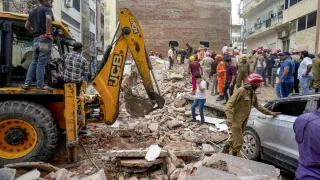
Jagran Correspondent, New Delhi: The tragic building collapse in Delhi's Satya Niketan has exposed the reality of the MCD's annual survey. A survey is conducted annually in Delhi to identify dangerous and dilapidated buildings, but the lack of timely action has put this exercise under question.
In 2021, the MCD declared a building in Gaffar Market dilapidated, based on a report from IIT Roorkee. Despite this, no effective action has been taken against the building. Thousands of shops still operate in the area.
Similarly, the corporation had declared building number 18 in Pocket B-6, B-Block, Krishna Kunj, Rohini Sector 15, dilapidated about four years ago, but no permanent solution was found and enforced.
The measures remained limited to barely erected barricades around the building and marking it as a danger zone. The reports have raised questions over accountability as such structures invite mishaps.
The situation isn't limited to private buildings. The MCD's zonal office in Old Delhi is also in a dilapidated state. The mortar is peeling off the walls, leaving the entire building in a state of ruins. Due to its proximity to the underground metro line, the building vibrates when the metro passes through.
The office stands as a testament to MCD's negligence, which failed to even repair its own buildings.
AAP councillor Ariba Khan recently raised the issue of the building's dilapidated condition at a standing committee meeting. The building houses the MCD's zonal property tax and education department offices.
Every year, the MCD conducts a survey of dangerous buildings before the monsoon. This year, around 30.7 lakh buildings were surveyed, but only 62 buildings were declared dangerous. The highest number of 19 buildings were identified in the Karol Bagh zone, nine in the West zone, eight in the Central zone, four in the South zone, and five in the City-Sadar Paharganj zone.
However, not a single dangerous building was found in the Shahdara North, Shahdara South, and Civil Lines zones. Despite this, incidents of building collapse have been reported in these areas as well. Given the rise in the number of cases related to building collapse, the data appears underreported.