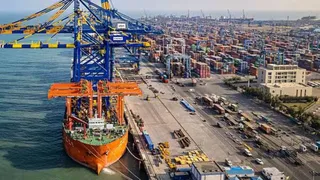
India boasts a coastline stretching 7,517 km, home to 13 major ports and over 200 notified small and medium-sized ports. These gateways handle approximately 95 per cent of the country's foreign trade by volume. Operations are divided between the central government, state governments, and Public-Private Partnership (PPP) models. While millions of tons of cargo pass through these ports annually, one specific location stands out as the leader in volume.
The Largest Cargo-Handling Port
Located in Gujarat, Mundra Port is India’s largest commercial and private port. Operated by Adani Ports and Special Economic Zone (APSEZ) of the Adani Group, it recently made history by becoming the first port in India to handle over 200 million metric tons of cargo in a single financial year (2024-2025). It serves as a vital economic gateway with the capacity to handle large containers, bulk and liquid cargo.
History And Origins
Mundra Port is both a private port and a Special Economic Zone (SEZ). It originated in 1998 as Gujarat Adani Port Limited (GAPL) and officially commenced operations in 2001. Initially financed by the government institution IFCI, its name was later changed to Mundra Port and Special Economic Zone.
Key Infrastructure And Features
The port is renowned for its world-class infrastructure. As a deep-draft, all-weather port, it provides multimodal connectivity to service the northern hinterlands of India. It houses the nation's largest coal import terminal and is designed with state-of-the-art facilities that ensure rapid cargo exit and minimal vessel turnaround times.
Diverse Cargo Capabilities
Mundra Port handles a vast array of commodities with high efficiency. Its operations include the management of:
- Fertilisers and agricultural products
- Minerals, ores and steel
- Project cargo and crude oil
- Liquid cargo and marine services
The facility is equipped with massive storage capacities, featuring both specialised covered warehouses and open storage areas to accommodate high volumes of trade.