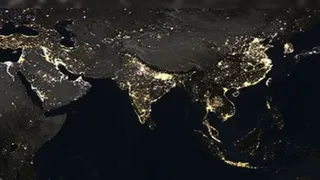
NASA recently released a new global map based on satellite imagery to show how nighttime light on Earth has changed between 2014 and 2022. Experts scanned at least 1.6 million satellite images, which were clicked each night for nine years to picture Earth.
The findings shocked the viewers. It showed that nightlights remarkably increased in areas of Uttar Pradesh and Bihar owing to their development.
ALSO READ: JK: Fire Erupts At Commercial Building Near Lal Chowk, 19 Gas Cylinders Recovered
Under the direction of Tian Li and Zhe Zhu at the University of Connecticut, the researchers analysed the pictures taken by the Visible Infrared Imaging Radiometer Suite (VIIRS) using a novel method. The purple portions represent evening lights, whereas the golden areas show greater nighttime lights.
The findings say that India, China, the Middle East, and Central America are mostly gold, while the US has gold areas on the west and covers purple and white areas on the east. Meanwhile, Europe was majorly purple, indicating that the region dimmed over these years.
How Did The Netizens React?
Netizens were shocked to discover that Bihar and Uttar Pradesh emerged as the brightest areas not only in India but in the entire world.
"Wait...Bihar is one of the most or maybe the brightest spot in the world??" said one user, while another added, "Bihar, the land of enlightenment, is the brightest."
ALSO READ: ‘Not Found,' ‘Regret’: IRCTC Users Report Failed Payments As Railways' Tatkal Booking Crashes
Another user said, "That brightening of the UP-Bihar belt is the most astounding thing India has achieved in the last 10-15 years. Getting electricity to every nook & cranny, increasing the industry, having the fastest rising per capita in India, and the population density that's benefiting all shine through directly into space."
A fourth said, "I criticise Bihar a lot, and I am not happy with the new CM, but on this front, the work has been amazing. With such population density, to provide 21-23 hours of uninterrupted electricity in normal days, which used to be 6-8 hours, is phenomenal."
The study included the majority of the inhabited world, with latitudes ranging from 60 degrees south to 70 degrees north. Light sources as small as a toll booth on a dark highway were captured by the scientists.
“Unlocking energy sector insights is just one way NASA data is advancing national security interests at a critical time,” said Miguel Roman, deputy director for atmospheres and data systems at NASA's Goddard Space Flight Center in Greenbelt, Maryland. “Earth at night has so much to teach us.”