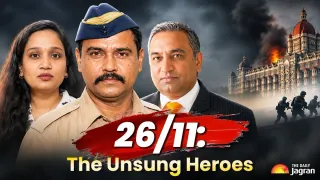
26/11 Mumbai Attacks: It has been 18 years since the 26/11 Mumbai terror attacks, in which 166 people lost their lives. Ten terrorists belonging to Pakistan-backed Lashkar-e-Taiba (LeT) entered Mumbai and unleashed terror across the city in November 2008. The attacks remain among the deadliest terror strikes in India's history.
The terrorists entered Mumbai by sea on the night of November 26, 2008. Over the next four days, they targeted several prominent locations, killing 166 people and leaving hundreds injured.
While the bravery of security personnel who fought the terrorists is widely remembered, several ordinary people also displayed extraordinary courage during those horrific hours. From a railway announcer who guided passengers to safety to hotel employees who helped guests escape, many risked their lives to save others.
26/11 Mumbai Attacks: Some Unsung Heroes
1. Karambir Singh Kang: The Taj General Manager Who Returned Amid the Attack
Employees of the Taj Mahal Palace Hotel showed remarkable courage as they tried to protect guests and help them escape during the attacks. Karambir Singh Kang, the hotel's general manager at the time, rushed back to the Taj after learning about the attack. Despite losing his wife, Neeti, and two sons, Uday and Samar, who were inside the hotel, he went inside to help others.
Kang continued coordinating evacuation efforts and helped guests and staff reach safety.
2. Tukaram Omble: The Policeman Who Helped Capture Kasab
Among the security personnel who confronted the terrorists, Assistant Sub-Inspector Tukaram Omble made the ultimate sacrifice while helping the police capture Ajmal Kasab alive.
On the night of November 26, Omble and other policemen were stationed at a checkpoint near Girgaum Chowpatty when a car carrying terrorists approached them.
When Kasab stepped out of the vehicle and opened fire, Omble rushed towards him and grabbed the barrel of his AK-47 rifle. Despite being shot several times, he refused to let go of the weapon.
His actions gave other policemen enough time to overpower Kasab and arrest him. Omble later died from his injuries.
His bravery played a crucial role in capturing the only terrorist who was arrested alive during the attacks. He was posthumously awarded the Ashoka Chakra, India's highest peacetime gallantry award.
3. Vishnu Zende: The Railway Announcer Who Guided Passengers To Safety
One of the remarkable stories of courage during the attacks came from Chhatrapati Shivaji Maharaj Terminus (CSMT), where railway announcer Vishnu Dattaram Zende was on duty when the terrorists opened fire.
Instead of running away, Zende picked up the microphone and began warning passengers. He made announcements in Hindi and Marathi, asking commuters to avoid the main hall and leave through the rear exit near Platform 1.
After noticing the terrorists moving towards the station area, he understood that passengers needed to be directed away from the danger.
Even when the attackers fired towards his announcement booth, Zende and his colleague took cover under their desks. Despite the threat to his own life, he continued making announcements and guiding people towards safer exits.
His timely warnings helped several passengers escape the station during the attack.
4. Devika Rotawan: The Young Survivor Who Testified Against Ajmal Kasab
Devika Rotawan was just nine years old when she was shot in the right leg during the firing at Chhatrapati Shivaji Terminus (CST).
Despite her injuries, she later appeared in court as a witness and identified Ajmal Kasab, the Pakistani terrorist who was captured alive. Her testimony became an important part of the prosecution's case against him.
Rotawan was travelling to Pune to visit her elder brother when she was caught in the attack. She recalled witnessing Kasab firing at people before a bullet struck her leg, leaving her unconscious.
Years later, she spoke about the incident and how the memories of that night continue to affect her.
Recalling the horrific experience, she said, "At nine years old, I didn't even know the word 'terrorism' or what it meant. All I knew was that I saw a man holding a large gun, firing indiscriminately. He seemed to derive pleasure from killing people. A bullet struck my right leg, and I collapsed, losing consciousness."
Her courage in identifying Kasab despite being a young survivor helped investigators establish his role in the attacks.
5. Mohammed Taufiq Sheikh: The Tea Vendor Who Warned People At CST
Mohammed Taufiq Sheikh, who worked as a tea seller at Chhatrapati Shivaji Terminus (CST), was collecting payments for tea deliveries when the firing began.
Realising that something was wrong, he rushed towards the long-distance booking counter and began shouting warnings, urging people to leave the station. His quick response helped several people move away from the danger.
Recalling that night, Sheikh said he was standing near a medical store when he heard a sound that initially resembled firecrackers. An India-England cricket match was also taking place, leading him to believe that India had won.
However, he soon realised that the sounds were gunshots and that a terror attack.
Recalling the incident, he said he hasn't been able to sleep till day.
"It’s been 18 years, and I still haven’t been able to sleep. I didn’t know when Kasab arrived. I had gone to collect payment for some tea. There was a huge crowd. The officials told me, "Wait outside; come back later, kid.” So, I stood outside. Suddenly, there was a sound—like firecrackers going off during Diwali. There was an India vs England match happening, so I thought India had won. But then I looked around; there were no police, no one in sight, just a stampede. I started shouting, "Run, a bomb has gone off..." I went inside, locked the gate, and alerted the officials...just then, someone walked in—I thought him to be a commando. But he shouted an expletive at me in Punjabi. He then took six steps back and fired three bullets. One hit a table, another shattered the glass, and the third ricocheted. I called my family to say, "This is the end for me," Taufiq Shaikh told ANI.
6. Mukesh Jadhav, A Home Guard At CST
Mukesh Jadhav, 23, was a Home Guard on duty at Chhatrapati Shivaji Terminus (CST) on 26/11.As gunfire broke out, he guided commuters to safety and tried to warn others. Even after being shot, he dragged himself to the police booth to alert the cops before collapsing.
His brother Santosh Jadhav told NDTV, "He wanted to do something for the country since childhood. Even after joining the Home Guard, he wanted to join the military, but they said he was too short. He told his friends, 'I will achieve something big."
7. Thomas Varghese: The Waiter Who Kept Saving, Even After Being Shot
Thomas Varghese was a senior waiter at Wasabi restaurant in the Taj. When the firing started on 26/11, he told the guests to crouch down and stay safe. Then he helped them leave the restaurant safely. He made sure everyone else left first. He was the last one to leave.
As he stepped out into the alley, the terrorists shot him. He gave his life to save others.
He was escorting some of the guests when he was shot in the leg.
"Even after he was shot, he called a colleague and asked him to rescue him. At that moment, a terrorist fired one more bullet into his upper body," said a friend, who also worked at the Taj and did not wish to be named, according to Hindustan Times.
About the 26/11 Mumbai Terror Attacks
The 26/11 Mumbai terror attacks took place on November 26, 2008, when 10 terrorists belonging to Pakistan-backed Lashkar-e-Taiba entered Mumbai through the sea route.
The attackers targeted several prominent locations, including the Taj Mahal Palace Hotel, the Oberoi Trident Hotel, Chhatrapati Shivaji Maharaj Terminus, Nariman House, Cama Hospital, Metro Cinema and Leopold Cafe.
These locations were chosen to cause maximum damage, as they were frequented by foreign nationals, tourists and local residents.
The attacks continued for nearly four days, ending on November 29, 2008. Nine of the 10 terrorists were killed during the security operation, while Ajmal Kasab was captured alive.
In May 2010, Kasab was sentenced to death. He was hanged at Yerawada Central Jail in Pune on November 21, 2012.
Eighteen years later, the bravery of the security personnel and ordinary citizens who risked their lives to save others remains an important part of the story of 26/11.