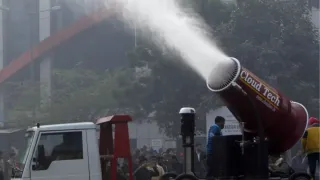
On Monday, the morning after Diwali, Delhi residents woke up to hazardous air quality following festive celebrations. The city’s Air Quality Index (AQI) surged past 350 overall, with several key areas breaching the severe threshold of 400. To mitigate the rising air pollution, the Delhi government deployed anti-smog guns across the capital to spray fine water droplets and purify the air.
What are anti-smog guns?
An anti-smog gun is a device that sprays fine nebulised water droplets into the air, making the most minute dust and pollutant particles absorbed. The device is connected to a water tank which is placed on a vehicle. The smog gun’s mechanism converts the water into a fine spray with droplet sizes of 50-100 microns by passing it through high-pressure propellers.
ALSO READ: Delhi Chokes After Diwali As Air Quality Plunges; AQI At 368, 12 Areas Record 'Severe' Pollution
ASG, also known as a spray gun, mist gun or water cannon, reduces air pollution by binding dust and other particulate matter (PM2.5 and PM10) and carrying them down to the ground level along with water. ASG makes a canopy effect and works like rain to bring down the suspended particles wafting in the atmosphere. The water spray can go up to a height of 150 feet and spew 30-100 litres per minute.
Apart from combating air pollution in cities, it also assists in controlling industrial dust in mining, grinding, coal, and stone crushing. Recently, the devices were also used after the demolition of the Noida twin towers.
How Impactful Are These?
According to environmentalists, these devices have their impact only for a limited time. Their effect is also restricted to a certain area or space when the spray operation is undertaken, they contend. It’s a temporary measure for quick relief, not a long-lasting solution.
ALSO READ: 'If India Is Pub, Delhi Is Smoking Zone': Netizens Cope With Delhi Smog Through Hilarious Memes
Delhi’s Air Quality Worsened On Diwali
The 24-hour average Air Quality Index (AQI) in Delhi settled at 376 on Sunday (November 8, 2026), placing it in the 'very poor' category. Out of 59 monitoring stations, 22 recorded 'very poor' air quality, while 12 stations slipped into the 'severe' category. Jahangirpuri recorded the highest individual AQI at 463.
As night fell and Diwali firecrackers were burst, pollution levels spiked further, with several stations crossing 400 and private monitors reporting higher localised numbers.