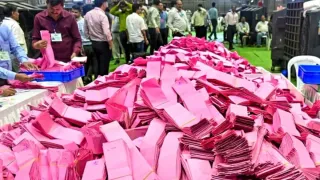
Amid the SIR controversy, Opposition Leader Rahul Gandhi has consistently advocated for returning to paper ballots over Electronic Voting Machines (EVMs). However, this stance faces heightened political scrutiny following the October 28, 2026, Legislative Council (MLC) election results. Held across 28 seats in Uttar Pradesh, Maharashtra, Bihar, and Karnataka using physical paper ballots, the elections yielded near-zero gains for the Congress party. This included losing all seats in Karnataka, a state where Congress currently holds power, providing the ruling Bharatiya Janata Party (BJP) further momentum to challenge the opposition's anti-EVM stance.
Despite a global push for digital governance, the majority of countries continue to rely on physical paper ballots for national elections. The decision by several technologically advanced countries to reject or outlaw EVMs remains the primary precedent anchor for India's anti-EVM coalition.
Over 90 per cent of nations rely on ballot papers
Over 90 per cent of countries globally still rely on manually marked paper ballots to conduct their national elections. The decision of several advanced and tech-heavy nations to abandon or explicitly ban Electronic Voting Machines (EVMs) forms the core international precedent cited by India’s opposition parties.
Among these, Germany completely discontinued the use of EVMs following a landmark 2009 Federal Constitutional Court ruling. The court declared that in a democracy, transparency is a constitutional right, but operational "efficiency" is not. It mandated that ordinary citizens must be able to verify and understand the vote-counting process without needing specialised computer engineering skills.
The Netherlands used electronic voting extensively from the late 1990s until 2007, when they officially abandoned the machines. The rollback took place after a public advocacy group demonstrated on live television that the machines could be manipulated within five minutes without leaving any recognisable trace.
Ireland initiated an EVM rollout but issued a permanent moratorium around 2009, scrapping the hardware entirely. This was driven by widespread public distrust regarding hardware integrity, combined with high storage and maintenance costs. Neither country has ever widely adopted or relied on EVMs for their national parliamentary or presidential elections, preferring the simplicity and high public trust of hand-counted paper ballots.
What’s Its Origin?
The Early American Ticket System:The first recorded paper ballot in America was used in 1629 to select a church pastor in the Massachusetts Bay Colony. For the next two centuries, paper ballots were not uniform or secret. Political parties printed their own colourful "tickets" listing only their candidates.Voters had to publicly drop these party slips into a glass box. Else everyone could see which party's slip you held; voter intimidation, bribery, and violence at the polling booths were rampant.
ALSO READ: Congress Wants Return To Ballot Paper But Lost Two Major Non-EVM Polls In A Month
The Secret Australian Ballot: The modern ballot paper as we know it today was initiated in Victoria and South Australia in 1856. This groundbreaking system introduced the concept of the Secret Ballot through three crucial changes:
The government, rather than the political parties, printed a single, uniform sheet of paper listing all candidates. For the first time, private voting stalls were constructed so voters could mark their papers away from public scrutiny. South Australia enhanced the system by instructing voters to place a simple "X" next to their preferred candidate, standardising the manual counting process.
The Australian Ballot
The "Australian Ballot" format became so successful at ending electoral violence and bribery that it quickly spread across the globe. The UK adopted the secret paper ballot via the Ballot Act of 1872. While the US widely adopted the system following the presidential election of 1884.
Shortly after gaining independence, India implemented the standard paper ballots paired with specialised metal ballot boxes during its landmark first post-independence general elections in 1951–1952, a system that remained entirely intact until the rollout of EVMs began in the late 1990s.As India's political battle over voting technology intensifies, the global consensus remains clear. In an era of rapid digital transformation, the simple, tangible paper ballot continues to stand as the world's most enduring safeguard of public trust.