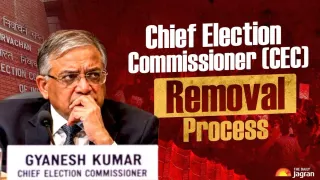
Removal Process of CEC: On Monday (October 5, 2026), the Supreme Court issued notices to the Election Commission and the Central Government. The Court sought a response within a week regarding a petition challenging the decision-making process of the Election Commission, led by Chief Election Commissioner Gyanesh Kumar. It is alleged that these decisions were taken without the approval of the two Election Commissioners.
A bench comprising Chief Justice of India Surya Kant and Justices Joymalya Bagchi and V. Mohana considered the arguments presented by Senior Advocate Vikas Singh and issued the notices.
The bench observed that decisions by the Election Commission should be made either unanimously or by a majority, as this is the standard procedure for all decisions.
Meanwhile, opposition parties are demanding the removal of the incumbent CEC, Gyanesh Kumar. In light of this, we have brought you a detailed explanation of the process for removing the CEC as part of our 'General Knowledge' series.
What Is The Procedure for Removal of CEC?
Here we bring you the procedure for the removal of the Chief Election Commissioner, step by step:
Notice of motion: MPs must move a motion in either House, alleging "proved misbehaviour or incapacity."
Signatures needed: At least 100 members in the Lok Sabha or 50 in the Rajya Sabha.
Presiding officer's call: The Speaker or Chairman may admit or reject the motion after consulting people and reviewing material.
Inquiry committee: If admitted, a three-member panel (a Supreme Court judge, a High Court Chief Justice and a distinguished jurist) investigates. The CEC gets a full chance to defend himself.
Parliamentary vote: If the panel finds him guilty, both Houses must pass the motion in the same session, by a majority of the total membership and two-thirds of those present and voting (A special majority under Article 368 of the Indian Constitution).
Presidential order: The President then issues the removal order, with no discretion at this stage.
Note: The inquiry follows the Judges (Inquiry) Act, 1968, which is why the process feels quasi-judicial rather than political.
Why Is the Bar So High?
Article 324(5) says the CEC can be removed only "in like manner and on the like grounds" as a Supreme Court judge. The Chief Election Commissioner and other Election Commissioners (Appointment, Conditions of Service and Term of Office) Act, 2023, repeats this in Section 11(2). Service conditions also cannot be changed to his disadvantage after appointment.
The idea is simple: the person who oversees elections should not be pushed out by whichever party holds power. Notably, the other two Election Commissioners get weaker protection, as they can be removed only on the CEC's recommendation.
Terminology matters too. Politicians say "impeachment," but the Constitution reserves that word for the President (Article 61). For judges and the CEC, the formal term is simply "removal."
What Counts As Grounds for Removal?
Only two grounds exist: proved misbehaviour or incapacity. Misbehaviour can include corruption or abuse of office, and courts have read it to cover conduct unbecoming the office or failure to perform duties. Incapacity means inability to do the job. Political disagreement or unpopular decisions, on their own, do not qualify.
Has It Ever Happened, and What's Different Now?
No CEC has ever been removed in India. The most recent attempt came in March 2026, when the Opposition submitted motions in both Houses, signed by 130 Lok Sabha and 63 Rajya Sabha members, citing the Special Intensive Revision of electoral rolls and alleged partisan conduct.
In April, the Speaker and the Rajya Sabha Chairman rejected them without giving reasons. The motions never reached the inquiry stage, which shows how much power the presiding officer's admission step holds.
What has changed is the source of criticism. An Indian Express investigation reported that Election Commissioners Sukhbir Singh Sandhu and Vivek Joshi recorded objections at least 14 times over ten months. When dissent comes from inside the Commission, the Opposition argues, it cannot be dismissed as political rivalry.
On Monday, October 5, the Supreme Court, with a Bench led by Chief Justice Surya Kant, issued notice to the Commission and the Centre, seeking replies within a week.
The Bench observed that Commission decisions must be unanimous or by majority, and said it presumed that was how all decisions were taken.
The Larger Question On CEC Independence:
The safeguard was built to protect independence, but critics now ask whether it also shields unaccountability. Supporters of the high bar say it is precisely what keeps the poll body free from political vendettas.
Both views point to the same thing: the real contest is likely to be decided at the first step, whether a presiding officer admits the motion at all.