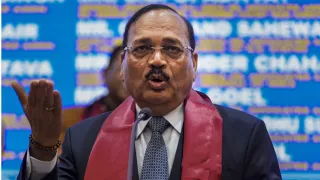
Chief Justice of India, Surya Kant, is in the news again after he called out the INDIA Bloc's protest march towards the Supreme Court earlier last week, over the alleged irregularities in the ongoing Special Intensive Revision (SIR) of electoral rolls. "Nobody can browbeat judiciary," CJI Surya Kant said, referring to Rahul Gandhi-led opposition MPs' march to the apex court.
He said that the doors of the Supreme Court are open for everyone, conditioned that leaders follow the law and file proper court petitions instead of asking for private political meetings. This decision has reiterated the power of the judiciary, choosing to maintain strict professional boundaries instead of holding closed-door meetings with political leaders.
Also Read: Mumbai-Pune Expressway Traffic Update: Restrictions Announced Till October 20; Check Diversions
All About CJI Surya Kant
Justice Surya Kant is the 53rd Chief Justice of India. Born on February 10, 1962, he is the first person from Haryana to hold the country's highest judicial position. Before joining the Supreme Court in 2019, he served as the youngest Advocate General of Haryana, a judge of the Punjab and Haryana High Court, and the Chief Justice of the Himachal Pradesh High Court. He took the oath as the CJI on November 24, 2025, and will serve until his retirement on February 9, 2027.
How Is CJI Appointed?
The Chief Justice of India is appointed under Article 124(2) of the Indian Constitution, keeping the judiciary independent from political interference.
1. Traditionally, the senior-most judge of the Supreme Court is chosen to be the next Chief Justice of India.
2. About one month before retiring, the current CJI proposes the name of the senior-most judge to the Law Minister.
3. The Law Minister then passes on this name to the Prime Minister.
4. The PM reviews the name and officially advises the President of India to approve the appointment.
5. The final appointment is then officially signed by the President of India. The new CJI takes the official oath at the Rashtrapati Bhavan.
Roles And Responsibilities Of CJI
The Chief Justice of India is the epitome of the Indian judicial system. As the "Master of the Roster," the CJI is responsible for deciding which judge will hear which cases. Leading the collegium, the CJI recommends the appointment of new judges to the High Courts and the Supreme Court. In cases where the court needs to explain or protect the rules of the Constitution, the CJI leads the legal debates.
List Of Chief Justices In India
Since its inception on January 26, 1950, there have been 53 Chief Justices of India. Justice Surya Kant is currently serving as the 53rd CJI.
Name | Appointment Date | Tenure |
Harilal Jekisundas Kania | 26 January 1950 | 1 year, 284 days |
Mandakolathur Patanjali Sastri | 7 November 1951 | 2 years, 57 days |
Mehr Chand Mahajan | 4 January 1954 | 352 days |
Bijan Kumar Mukherjea | 23 December 1954 | 1 year, 39 days |
Sudhi Ranjan Das | 1 February 1956 | 3 years, 241 days |
Bhuvaneshwar Prasad Sinha | 1 October 1959 | 4 years, 122 days |
Pralhad Balacharya Gajendragadkar | 1 February 1964 | 2 years, 42 days |
Amal Kumar Sarkar | 16 March 1966 | 105 days |
Koka Subba Rao | 30 June 1966 | 285 days |
Kailas Nath Wanchoo | 12 April 1967 | 318 days |
Mohammad Hidayatullah | 25 February 1968 | 2 years, 294 days |
Jayantilal Chhotalal Shah | 17 December 1970 | 35 days |
Sarv Mittra Sikri | 22 January 1971 | 2 years, 93 days |
Ajit Nath Ray | 26 April 1973 | 3 years, 276 days |
Mirza Hameedullah Beg | 29 January 1977 | 1 year, 24 days |
Yeshwant Vishnu Chandrachud | 22 February 1978 | 7 years, 139 days |
Prafullachandra Natwarlal Bhagwati | 12 July 1985 | 1 year, 161 days |
Raghunandan Swarup Pathak | 21 December 1986 | 2 years, 209 days |
E. S. Venkataramiah | 19 June 1989 | 181 days |
Sabyasachi Mukharji | 18 December 1989 | 281 days |
Ranganath Misra | 26 September 1990 | 1 year, 59 days |
Kamal Narain Singh | 25 November 1991 | 17 days |
Madhukar Hiralal Kania | 13 December 1991 | 340 days |
Lalit Mohan Sharma | 18 November 1992 | 85 days |
M. N. Venkatachaliah | 12 February 1993 | 1 year, 254 days |
Aziz Mushabber Ahmadi | 25 October 1994 | 2 years, 150 days |
Jagdish Sharan Verma | 25 March 1997 | 298 days |
Madan Mohan Punchhi | 18 January 1998 | 264 days |
Adarsh Sein Anand | 10 October 1998 | 3 years, 21 days |
Sam Piroj Bharucha | 1 November 2001 | 185 days |
Bhupinder Nath Kirpal | 6 May 2002 | 185 days |
Gopal Ballav Pattanaik | 8 November 2002 | 40 days |
Vishweshwar Nath Khare | 19 December 2002 | 1 year, 134 days |
S. Rajendra Babu | 2 May 2004 | 29 days |
Ramesh Chandra Lahoti | 1 June 2004 | 1 year, 152 days |
Yogesh Kumar Sabharwal | 1 November 2005 | 1 year, 73 days |
Konakuppakatil Gopinathan Balakrishnan | 14 January 2007 | 3 years, 117 days |
Sarosh Homi Kapadia | 12 May 2010 | 2 years, 139 days |
Altamas Kabir | 29 September 2012 | 292 days |
Palanisamy Sathasivam | 19 July 2013 | 281 days |
Rajendra Mal Lodha | 27 April 2014 | 153 days |
Handyala Lakshminarayanaswamy Dattu | 28 September 2014 | 1 year, 65 days |
Tirath Singh Thakur | 3 December 2015 | 1 year, 31 days |
Jagdish Singh Khehar | 4 January 2017 | 235 days |
Dipak Misra | 28 August 2017 | 1 year, 35 days |
Ranjan Gogoi | 3 October 2018 | 1 year, 45 days |
Sharad Arvind Bobde | 18 November 2019 | 1 year, 156 days |
Nuthalapati Venkata Ramana | 24 April 2021 | 1 year, 124 days |
Uday Umesh Lalit | 27 August 2022 | 73 days |
Dhananjaya Yeshwant Chandrachud | 9 November 2022 | 2 years, 1 day |
Sanjiv Khanna | 11 November 2024 | 183 days |
Bhushan Ramkrishna Gavai | 14 May 2025 | 193 days |
Surya Kant | 24 November 2025 | Incumbent (Active) |