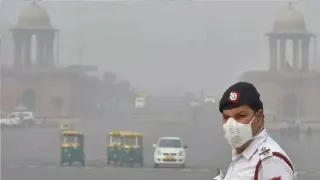
Delhi Air Pollution: Delhi's air quality continued to linger in the 'poor' category on Friday, recording an overall Air Quality Index (AQI) of 230. Official data indicates no significant improvement in pollution levels over the next nine days.
Delhi AQI Today: Station-Wise Data
According to data from the Central Pollution Control Board's (CPCB) Sameer app, three out of 56 monitoring stations across the national capital recorded air quality in the 'very poor' category, with Pusa registering the city's worst reading with an AQI of 324. While 36 stations logged 'poor' air quality, the remaining 17 stations recorded readings in the 'moderate' range.
As per CPCB, an AQI between zero and 50 is classified as 'good', 51 to 100 as 'satisfactory', 101 to 200 as 'moderate', 201 to 300 as 'poor', 301 to 400 as 'very poor', and 401 to 500 as 'severe'.
Stagnant Winds And Low Ventilation Index Behind 'Poor' AQI
Forecasts by the Air Quality Early Warning System indicate that Delhi's air quality will remain in the 'poor' zone from October 23 to October 26 and is likely to stay unchanged over the subsequent six days.
Atmospheric conditions remain unfavourable for the dispersion of pollutants due to a ventilation index under 6,000 square metres per second and an average wind speed of less than 10 kilometres per hour.
What Is Driving Delhi's Air Pollution?
Data from the Decision Support System for Air Quality Management (IITM Pune) shows that vehicular transport is the largest contributor, accounting for 20.3 per cent of Delhi's air pollution. Residential sources account for 5.2 per cent, industries contribute 4.2 per cent, construction activity stands at 2.6 per cent, energy at 2 per cent, waste burning at 1.8 per cent, road dust at 1.4 per cent, and other sectors at 1.3 per cent. Stubble burning contributed 5.1 per cent, while other sources accounted for 9.5 per cent.
Among neighbouring National Capital Region (NCR) districts, Gurugram's contribution to Delhi's pollution was the highest at 8.8 per cent, followed by Jhajjar at 6.1 per cent and Gautam Buddha Nagar at 4.7 per cent. Ghaziabad contributed 3.7 per cent, Sonipat 3.5 per cent, Faridabad 3.3 per cent, Panipat 2.8 per cent, Alwar 2.4 per cent, Baghpat 2.1 per cent, Rohtak 2 per cent, Rewari 1.8 per cent, Bulandshahr and Bhiwani 0.8 per cent each, Mahendragarh 0.7 per cent, and Karnal 0.6 per cent.
IMD Forecasts Partly Cloudy Skies
Data from the India Meteorological Department (IMD) shows that Delhi's base weather station, Safdarjung, recorded a maximum temperature of 32.2 degrees Celsius and a minimum of 19 degrees Celsius. Palam recorded a high of 29.8 degrees Celsius and a low of 18.3 degrees Celsius. Lodhi Road recorded a maximum of 32 degrees Celsius and a minimum of 18.6 degrees Celsius, while the Ridge station registered a maximum of 31.3 degrees Celsius and a minimum of 19.2 degrees Celsius. Ayanagar recorded a high of 31.6 degrees Celsius and a low of 19.1 degrees Celsius.
The IMD has forecast partly cloudy skies for Saturday, with the maximum temperature expected to settle around 33 degrees Celsius and the minimum near 19 degrees Celsius.
(With Inputs From PTI)