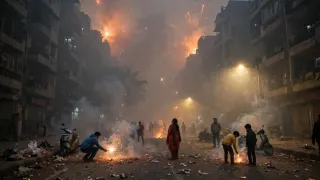
Delhi residents woke up to a thick layer of smog on Friday as air quality worsened, with the overall Air Quality Index (AQI) reaching 391. The situation is worrying as Diwali celebrations have not even begun yet.
Around 30 monitoring stations recorded 'severe' air quality at 9 am, while the remaining stations were in the 'very poor' category. Rohini recorded the highest AQI at 475, followed by IIT Delhi at 472.
Firecrackers during Diwali make the situation worse. The rising pollution also comes during the peak stubble-burning season, with smoke from farm fires in Punjab and Haryana adding to Delhi-NCR's pollution. Vehicle emissions, construction dust and other sources are also contributing to the poor air quality.
However, firecracker emissions typically contribute 20 per cent to 40 per cent of Delhi's total air pollution on Diwali. Their contribution can reportedly rise to over 70 per cent during peak nighttime hours between 9 pm and 5 am during Diwali.
Last year, in 2025, the Supreme Court initially refused to relax the firecracker ban but later allowed the sale and bursting of QR-code-verified green crackers during restricted morning and evening hours.
Despite these restrictions, Delhi recorded some of its worst post-Diwali air quality levels in five years. This happened even as stubble-burning incidents reportedly fell by 77.5 per cent.
According to an NDTV report, average PM2.5 levels reached 488 micrograms per cubic metre after Diwali. Pollution levels also increased by 212 per cent compared to pre-Diwali levels, raising questions about whether green crackers actually helped reduce pollution.
Delhi Pollution: How Bad Was The Air Quality After Diwali 2025?
Despite restrictions on firecrackers, Delhi's air quality worsened sharply after Diwali last year.
According to the NDTV report, PM2.5 levels reached an average of 488 micrograms per cubic metre, highlighting how polluted the air became after the celebrations.
Air pollution also reached a three-year high after the Supreme Court allowed the bursting of green firecrackers during specific hours.
A comparison of AQI levels over the years shows that pollution has remained a major concern around Diwali.
In 2024, Delhi recorded an AQI of 328 on Diwali, compared to 218 in 2023 and 312 in 2022. These figures show that green crackers have not been able to prevent a rise in pollution after the festival.
Four-year data from the Central Pollution Control Board (CPCB) also showed that Diwali 2025 was among the most polluting festive periods in recent years.
However, the situation in 2026 is already looking concerning. Delhi recorded an average AQI of 391 on Friday, just ahead of Diwali.
Delhi AQI Before And After Diwali: 2025 vs 2026
A comparison of pollution levels during the two festive periods shows that Delhi's air quality has already worsened even before Diwali celebrations begin this year.
In 2025:
- Diwali Eve (October 19): 296 ('Poor' category)
- Diwali Day (October 20): 345 ('Very Poor' category)
- Day After Diwali (October 21): 351 ('Very Poor' category)
In 2026:
- November 3: 389 ('Very Poor' category)
- November 4: 445 ('Severe' category)
- November 5: 412 ('Severe' category)
- November 6: 391 ('Very Poor' category)
The figures show that Delhi has already recorded very high pollution levels before Diwali. This raises concerns about how much worse the air quality could become after people burst firecrackers.
Delhi AQI On Diwali And The Day After: A Look At The Last Five Years
AQI data from the last five years shows a common trend: air quality usually gets worse the day after Diwali.
Firecracker smoke adds to the existing pollution, while low wind speeds and temperature inversion during late autumn make it difficult for pollutants to disperse. As a result, polluted air remains trapped close to the ground.
ALSO READ: Grap 3 Curbs Imposed In Delhi-NCR As AQI Drops To Severe Category | What’s Closed
Severe Spikes In 2021 And 2023
The biggest post-Diwali pollution spikes were recorded in 2021 and 2023.
In 2023, the AQI jumped by 220 points, rising from 218 ('Poor') on Diwali to 438 ('Severe') the following day.
A similar situation was seen in 2021, when the AQI increased from 382 ('Very Poor') to 462 ('Severe'). This was the highest pollution level recorded in the five-year data.
ALSO READ: 'Enjoying Weather?': SC Calls For Curbs On Vehicular Pollution As Delhi AQI Breaches 400-Mark
High Pollution In 2022, 2024 And 2025
Even in years when AQI did not enter the 'Severe' category, pollution remained high.
In 2022, 2024 and 2025, Delhi's air quality remained in the 'Very Poor' category on both Diwali and the following day. However, pollution levels increased further after the celebrations.
- 2022: AQI rose from 312 to 315.
- 2024: AQI rose from 330 to 359.
- 2025: AQI rose from 345 to 351.
The data shows that Delhi already struggles with seasonal pollution around Diwali. Firecracker smoke adds to the problem and can push AQI levels into the 'Severe' category, increasing health risks for residents.
Supreme Court Allows Green Crackers Only Across Delhi-NCR This Year
The Supreme Court has allowed certified green firecrackers to be burst in Delhi-NCR for two days during Diwali. However, the court has directed that a complete ban on firecrackers will return from November 9.
The relaxation comes with strict conditions on the sale and bursting of green crackers. Their use has been allowed only during specified hours on November 7 and November 8.
With Delhi already recording high pollution levels before Diwali, concerns remain over the impact of firecrackers on the city's air quality for this year.