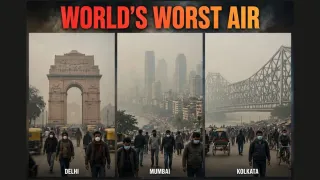
Three of India's biggest cities-- Delhi, Mumbai and Kolkata have featured among the world's 10 most polluted major cities, highlighting how air pollution is no longer limited to the national capital but has become a growing health concern across the country.
According to Swiss air quality monitoring platform IQAir's live ranking, as of 1 pm on November 13, Delhi ranked third globally with an AQI of 160, making it the most polluted Indian city on the list. Mumbai stood at sixth position with an AQI of 158, while Kolkata ranked ninth with an AQI of 151.
Bishkek in Kyrgyzstan topped the list with an AQI of 179, followed by Tehran in Iran at 174. Beijing in China ranked fourth with an AQI of 160, while Kampala in Uganda took the fifth spot with 158. Chongqing in China ranked seventh with 155, followed by Kabul in Afghanistan at 152. Dhaka in Bangladesh rounded off the top 10 with an AQI of 138.
IQAir uses the US Environmental Protection Agency's (EPA) Air Quality Index (AQI) scale, under which a reading of 0–50 is considered good, while levels above 100 are considered unhealthy.
Delhi's air quality turns severe
A thick blanket of smog covered Delhi on Friday as the city's air quality slipped into the severe category for the first time this season. The national capital recorded an average AQI of 403 at 7 am, according to the Central Pollution Control Board (CPCB).
IIT Delhi recorded the worst air quality, with an AQI of 488, followed by Chandni Chowk at 479 and Delhi University's North Campus at 478. Burari Crossing recorded 456, while ITO and Jawaharlal Nehru University both reported 451.
Of the 58 monitoring stations that recorded data at 8 am, 33 were in the severe category, 24 in the very poor category and one in the moderate category. The dense smog also reduced visibility in several parts of the city.
The Commission for Air Quality Management (CAQM) had invoked Stage III of the Graded Response Action Plan (GRAP) across the National Capital Region on November 6, anticipating a further deterioration in air quality.
Under Stage III restrictions, several dust-generating construction and demolition activities are banned across the NCR. The measures also include the closure of stone crushers and mining activities, along with restrictions on the movement of certain categories of vehicles.