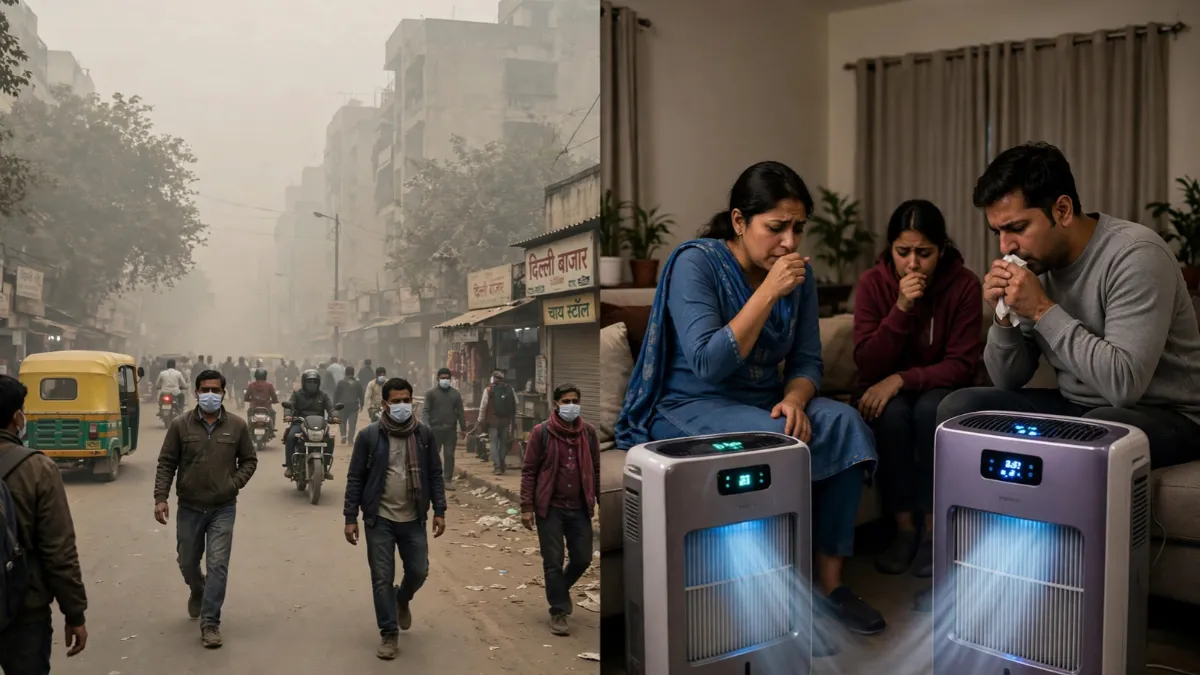
- Delhi's AQI hits 403, marking severe air quality.
- Hospitals report 7-10% rise in respiratory cases.
- Doctors recommend N95 masks, air purifiers, avoiding morning walks.
Delhi Air Pollution: Delhi's air quality turned severe for the first time this season on Friday morning, with the national capital recording an average Air Quality Index (AQI) of 403 at 7 am, according to the Central Pollution Control Board (CPCB).
Of the 58 monitoring stations that recorded data at 8 am, 33 were in the severe category, 24 in the very poor category and one in the moderate category. IIT Delhi recorded the highest AQI at 488, followed by Chandni Chowk at 479 and Delhi University's North Campus at 478.
The national capital has been witnessing high pollution levels since Diwali, with firecracker celebrations adding to the pollution. A thick layer of grey smog has since covered the city, raising concerns over breathing difficulties, poor visibility and other health problems.
Recommended For You
To understand how the rising pollution levels are affecting people's health, The Daily Jagran spoke to Dr Girish Sindhwani, Head of the Department of Pulmonary Medicine at AIIMS Rishikesh, Dr Tanu Kumar, a paediatrician at a Delhi government hospital and Dr Avi Kumar, Additional Director and Head of the Department of Pulmonary Medicine at Fortis Escorts.
Delhi Hospitals Report Rise In Respiratory Cases
Dr Avi Kumar said Fortis hospitals in Delhi had recorded a 7-10 per cent increase in outpatient department (OPD) cases and a 5-7 per cent rise in hospital admissions over the past three to four days as air quality started to worsen.
He said there has been a noticeable increase in cases of allergies, pneumonia and respiratory infections. Even people who had never experienced breathing problems before were reporting allergy-related symptoms amid the worsening pollution.
He added that hospitalisations had increased due to worsening respiratory conditions and infections. They also noticed a 5-7 per cent rise in oxygen requirements among patients.
According to Dr Kumar, elderly people and those with asthma are among the worst affected by the current pollution levels.
Which Symptoms Should You Not Ignore?
Dr Kumar said people should not ignore a drop in oxygen levels, unusual breathlessness or a fever that does not subside. These symptoms require immediate medical attention.
He advised people to use air purifiers, stay hydrated and try steam inhalation before sleeping. He also recommended wearing masks when stepping outside.
On the effectiveness of N95 masks, Dr Kumar said they can filter up to 95 per cent of particulate matter when worn properly.
He advised Delhi residents who need to step out for work to spend as much time indoors as possible, wear masks outdoors and maintain good hydration.
Children and Asthma Patients Among the Worst Affected
Dr Tanu Kumar, a paediatrician at a Delhi government hospital, said the hospital had recorded nearly a 5 per cent increase in respiratory cases in its OPD.
She said doctors were seeing more patients with allergies, asthma, chest infections and prolonged coughs.
She also pointed out that several patients who had never experienced breathing problems before were now reporting wheezing (a sound during breathing). There had also been an increase in the need for nebulisation among patients.
On masks, she said an N95 mask with a proper seal can filter up to 95 per cent of particulate matter, while an N99 mask can filter up to 99 per cent when fitted correctly.
ALSO READ: Delhi Post-Diwali AQI: Did The Air Get Cleaner Or Worse? What 3 Years Of Data Reveal
She advised people to wear N95 masks, stay hydrated and limit physical activity while outdoors.
Air Pollution Can Increase Risk of Heart Attacks, BP Issues
Dr Girish Sindhwani, Head of the Department of Pulmonary Medicine at AIIMS Rishikesh, warned that exposure to polluted air does not only affect the lungs but can also harm other organs, including the heart.
He said, "There are studies to show that this toxic air with this high AQI of more than, right now it is more than 150-200 in Delhi, affects not only the lungs. It not only affects the airway disorders like asthma and COPD; these diseases have a harmful effect from the air pollution with this high AQI, but also it also affects the other systems and other organ systems of the body. Like it can increase the risk of heart attacks and blood pressure. So all these are interrelated. There are systemic effects of pollution, air pollution.
So yes, it affects not only the lungs but also the heart and other organ systems."
Morning Walks, Open Windows: What Are People Getting Wrong?
When asked about common mistakes people make during high pollution levels, including going for morning walks, opening windows and not wearing masks, Dr Sindhwani advised people to avoid outdoor activities when pollution levels are high.
He said, "About morning walks: see, when the AQI is high, the PM 2.5 is the measurement criterion. If that is very high, more than 150 or even more than 100, what happens in the early morning times, especially during winters? This becomes apparent at a surface level, and in the early morning if you go for a walk, you are at a high risk of inhaling this particulate matter.
So yes, people who have some underlying health issues like COPD or asthma or an elderly population should avoid going for early morning walks, especially in winters."
He said if the pollution level is very high, you can keep yourself indoors.
He further said, "An N95 or N99 mask will give you some protection. So whenever elderly patients, elder-age group people, or patients with asthma or long-standing airway respiratory issues go outdoors and in areas which are overcrowded, they should be wearing a mask, preferably an N95 mask. And if N95 is not available, they can even wear a double surgical mask as well."
Does Air Purifier Help?
For people who do not have an air purifier at home, Dr Sindhwani said purifiers could offer some protection, particularly for elderly people and those who spend most of their time indoors. However, he stressed that they only work in a limited area and must be used correctly.
He said, "Air purifiers are of a little benefit, and their benefit is not documented by studies. However, for patients or the elderly population, if they are homebound and they want to avoid the harmful effects of air pollution, then air purifiers work for a limited area, say they work for a room. They will not clean the air of the whole house. So, the room has to be proper, the AC should be turned on, and the windows should always be closed. If the windows open or the air in the room comes in contact with outside air frequently, then the effect of the purifier is gone."
He also said some people are using and thinking that putting purifiers in their office chamber or in their cars will help. No.
Is Indoor Air Also Unsafe In Delhi Homes?
Dr Sindhwani said indoor air in Delhi homes could also be unsafe because outdoor and indoor air are connected, particularly when windows and doors are left open.
He said, "Yes, indoor air in Delhi homes also is now unsafe because the outside and inside air are interconnected. The outside air also goes in when the rooms are open, when the windows are open.
And the ideal AQI is less than 50, but we are not seeing this happening in the future, in the near future, unless very drastic or year-long efforts are done by the government to reduce air pollution."
He added that people using air purifiers could consider switching them on when the AQI crosses 100, while following the manufacturer's guidelines.
What Delhi Residents Should Do Before Stepping Out For Work
For people who cannot avoid travelling outdoors for work, Dr Sindhwani advised avoiding early morning walks and wearing masks whenever they step outside.
He said, "For the general population, to sum up: in winters, try to avoid early morning walks. If you at all have to go, then go with an N95 mask. Avoid going to overcrowded areas where there is a high risk of transmission of viral infections. So avoid overcrowded places, and if at all we have to go, then use a mask."