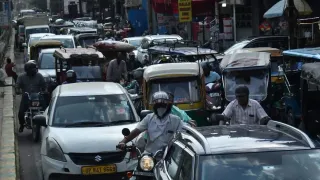
Workers spend an average of Rs 785 per month commuting to fixed workplaces, with urban workers incurring higher travel costs of Rs 1,044 compared to Rs 612 for their rural counterparts, according to a government survey.
The National Statistics Office (NSO), under the Ministry of Statistics and Programme Implementation (MoSPI), released key indicators and findings from the first-ever National Household Travel Survey (NHTS), conducted between July 2025 and June 2026, through a Factsheet.
For the survey, a trip is defined as travel covering a distance of more than 1 km.
According to the study, the average worker commute cost was Rs 785 per month, with workers commuting to a fixed workplace spending Rs 1,044 per month in urban areas and Rs 612 per month in rural regions.
Male workers spend an average of Rs 835 per month on fixed-workplace commutes compared to Rs 533 per month for female workers.
Urban students spend an average of Rs 617 per month on trips to and from educational institutions compared to Rs 361 per month in rural India.
About 57.6 per cent of workers travel more than 1 km to work. Over half of all workers aged 15 years and above perform within-travel-day trips to fixed or non-fixed workplaces (54.5 per cent rural vs 64.1 per cent urban).
States such as Rajasthan, Gujarat and Madhya Pradesh show average travel times of around 20–23 minutes, with higher travel times in parts of southern India.
About 61.9 per cent of male workers undertake daily work trips covering more than 1 kilometre compared to 41.9 per cent of female workers nationwide.
Two-wheelers are the single largest primary mode of transport for workers across India (37.1 per cent rural; 52.3 per cent urban).
While monorail, metro, suburban rail, and trams account for 5 per cent of urban worker commutes nationally, usage surges in Maharashtra (20.7 per cent), West Bengal (16.5 per cent), and Delhi (14.4 per cent).
About 83.4 per cent of workers commute in under 30 minutes. Over four-fifths of workers reach their fixed workplace within half an hour (86.1 per cent rural; 79.3 per cent urban), while 13.7 per cent take 30 - 60 minutes.
Average travel time from origin is 23 minutes for students (23 min rural; 22 min urban) and 25 minutes for workers travelling to a fixed workplace (23 min rural; 27 min urban).
Nearly 9 in 10 students complete their journey to educational institutions in up to 30 minutes (86.6 per cent rural; 89.6 per cent urban).
About 66.4 per cent of students commute more than 1 km daily.
Nearly two-thirds of students aged 6 years and above undertake within-travel-day trips of at least 1 km to attend their basic course educational institution (65.6 per cent in rural areas; 68.1 per cent in urban areas).
Trips less than one kilometre were not recorded. North-eastern states, including Assam and neighbouring states, show considerably less travel time (15 to 19 minutes).
Students aged 15-29 years record the highest regular trip participation at 79.1 per cent in rural India and 73.3 per cent in urban India for daily commute to attend educational institutes.
About 37 per cent of school students walk to school, followed by bus (29.5 per cent) and bicycles (15.8 per cent).
Auto-rickshaws serve 10.5 per cent of commuting students overall (rising to 14.4 per cent in urban areas), and two-wheelers account for 6.7 per cent (11.5 per cent in urban areas).
About 73.5 per cent of overnight trips rely on bus and rail. Buses (55.8 per cent) and inter-city railways (17.7 per cent) are the primary modes for household overnight travel, followed by cars (15.1 per cent) and two-wheelers (8.8 per cent).
About 22.7 per cent of urban households choose rail for overnight trips.
Railway usage for overnight journeys is about 14 per cent among rural households and around 22.7 per cent among urban households.
Disclaimer: Except for the headline, this article has not been edited by The Daily Jagran staff and has been published through a syndicated feed by PTI.