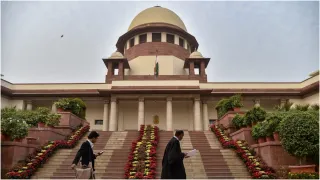
Days after the Supreme Court referred the case related to the 2023 law governing the CEC's appointment to a five-judge Constitutional Bench over a split opinion, a fresh plea has been filed to recall the order, citing concern over Justice Satish Chandra Sharma's son appearing as counsel for the Election Commission of India (ECI).
In a fresh plea, petitioner Naman Sherstra has challenged the validity of the September 23 order by the bench of Justices Dipankar Dutta and SC Sharma, arguing that the latter should have recused himself as his son appears for the poll body before the Madhya Pradesh High Court.
The plea further adds that the matter was heard by the bench on five occasions but Justice Sharma not once disclosed the fact or sought recusal on this ground.
The petitioner stated that the fact became public from news reports that surfaced two days after the September 23 order.
"The question is whether the established circumstances, viewed objectively, give rise to a reasonable apprehension concerning impartiality," the plea stated.
The plea clarified, "The present application does not impute actual bias, motive or want of good faith to the judge concerned…if this court finds the objection well-founded, (there be) fresh consideration of the question of reference by an appropriate bench constituted by the CJI."
This is the second such petition, as on Tuesday, a curative petition was also filed by Dr Jaya Thakur, also one of the petitioners in the matter.
Her plea contended that the case is fully covered by the 'reasonable likelihood of bias' and 'real danger test' laid down by the Supreme Court
What did the SC rule on Sept 23?
On September 23, a bench of Justices Dipankar Dutta and Sharma referred the case to CJI Surya Kant to consider constituting a five-judge bench after Dutta observed that the law can be considered on the settled principles laid down by earlier judgements. Justice Sharma, on the other hand, had held a different view and stressed the need for the matter to be taken up by a larger bench.
Justice Sharma observed that substantial questions on the interpretation of the Constitution arise in the matter. He added that under Article 145(3), the matter should be heard by a bench of at least five judges of the Supreme Court.