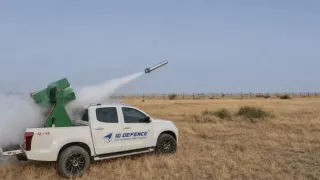
Indian defence company IG Defence has successfully test-fired its JWALA MK-1 autonomous counter-drone micro-missile system at the Pokhran firing range in Rajasthan, introducing an indigenous hard-kill solution designed to counter low-cost unmanned aerial threats.
Described by the company as India's first autonomous Counter-Unmanned Aircraft System (CUAS) micro-missile, the platform is engineered to engage hostile drones at distances of 2 to 5 km and altitudes ranging from 50 metres to 5,000 metres.
ALSO READ: DRDO Tests Indigenous 'Pralay' Missile Off Odisha Coast | Check Payload, Range, And Specifications
How JWALA MK-1 Works
At the core of JWALA MK-1 is GRID, an artificial intelligence-based mission autonomy and battle management system developed by IG Defence. The system integrates multi-sensor data, identifies and classifies potential aerial targets, and coordinates autonomous engagement decisions from initial threat detection to interception.
JWALA MK-1 Specifications And Capabilities
Engineered for rapid deployment and high flight manoeuvrability, the interceptor uses a dual-pulse solid rocket motor paired with aerodynamic fin controls. Rather than relying solely on a direct hit, the missile carries a pre-fragmented high-explosive warhead fitted with a proximity fuse that detonates near its target.
Mounted on a truck-based, multiple-canister launcher integrated with 4x4 vehicles for mobility across different locations, the system is also suited to counter drone swarms. Splinters from the pre-fragmented warhead create a debris cloud capable of disabling multiple nearby unmanned aerial vehicles simultaneously.
Counter-Drone Systems In India
The test comes amid lessons from conflicts in Ukraine and West Asia, where inexpensive reconnaissance and attack drones have forced militaries to expend costly air defence interceptors. While IG Defence has not yet disclosed per-engagement costs or specific trial metrics, such as engagement conditions, target counts, or induction timelines, a dedicated micro-missile offers a more economical hard-kill layer alongside existing air defence guns such as the L-70 and Zu-23.
Across India's broader counter-drone ecosystem, Solar Defence and Aerospace and Economic Explosives are developing the Bhargavastra micro-missile system, while the Defence Research and Development Organisation (DRDO) is pursuing directed-energy weapons, including high-energy lasers, alongside electronic soft-kill technologies.
IG Defence Nellore Facility And Army Kamikaze Drone Trials
Alongside JWALA MK-1, IG Defence is developing KAL, a long-range loitering munition, and T-SHOOL, a beam-based electronic countermeasure system, with plans to integrate both into its GRID architecture. To support domestic manufacturing, the company is establishing a missile and propulsion facility spread across roughly 200 acres in Nellore, Andhra Pradesh.
Simultaneously, the Indian Army is conducting trials at Pokhran for domestic firms to TEST jet-powered kamikaze drones, a high-speed weapon class extensively used by Russia against Ukraine due to the difficulty air defences face in intercepting them.