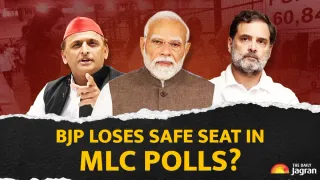
BJP MLC Elections: The MLC election results across 28 constituencies in four states have delivered mixed outcomes for the BJP and the Samajwadi Party (SP), while the Congress suffered a major setback. The Congress won just one seat despite contesting 12, while the BJP and its allies secured 16 of the 28 seats that went to polls on October 23 in Karnataka, Maharashtra, Bihar and Uttar Pradesh.
Despite BJP won several seats in MLC elections, the saffron party's overall performance was overshadowed by defeats in two politically significant constituencies-- Nagpur, home to the Rashtriya Swayamsevak Sangh (RSS) headquarters, and Varanasi, Prime Minister Narendra Modi's parliamentary constituency.
Both results have raised questions about the BJP's ability to retain its influence in regions considered important to its political identity.
Varanasi: BJP fails to wrest MLC seats in PM Modi's constituency
Varanasi, which has elected Prime Minister Narendra Modi to the Lok Sabha since 2014, delivered a setback to the BJP in the MLC elections. The Samajwadi Party retained both the Varanasi Teachers' and Graduates' constituencies, repeating its performance in 2020.
Despite the BJP's strong presence in the region, it failed to dislodge the SP from either seat. While the two MLC constituencies cover a wider geographical area than Modi's Lok Sabha constituency, the outcome carries political significance because of Varanasi's association with the Prime Minister.
The BJP, however, secured several other seats in Uttar Pradesh, including the Agra Graduates' constituency, Bareilly-Moradabad Teachers' constituency, Lucknow Teachers' constituency, Meerut Teachers' and Graduates' constituencies, and Gorakhpur-Faizabad Teachers' constituency.
Nagpur: Congress retains seat in RSS stronghold
The BJP suffered another setback in Nagpur, a city widely regarded as the RSS's ideological headquarters.
In a closely contested election, Congress candidate and sitting MLC Abhijeet Wanjari defeated his nearest BJP rival by 3,271 votes to retain the Nagpur Division Graduates' constituency.
The defeat is particularly significant as Nagpur is also the hometown of Maharashtra Chief Minister Devendra Fadnavis and Union Minister Nitin Gadkari. Both leaders campaigned extensively for BJP candidate Kohale.
The constituency had previously been represented by Gadkari for several terms. In 2020, Wanjari defeated BJP leader Sandip Joshi to win the seat. By retaining it in 2026, the Congress prevented the BJP from reclaiming a constituency it had dominated for decades.
ALSO READ: MLC Election Results: Who Won, Who Lost On 28 Seats Across 4 States? Check Constituency-Wise List
What do the MLC results mean for the BJP, Congress and SP?
Although the BJP and its allies secured the highest number of seats overall, the defeats in Nagpur and Varanasi highlight the party's difficulty in reclaiming certain constituencies despite its strong political presence.
The Congress faces a different challenge. Winning just one seat despite contesting 12 highlights its limited success in these elections. However, retaining Nagpur offers the party a significant victory in a politically sensitive constituency like Maharashtra where BJP holds a strong dominance.
For the Samajwadi Party, the results in Uttar Pradesh provide encouragement ahead of the 2027 Assembly elections. The party won five seats in the state and retained both Varanasi constituencies, challenging the BJP in a region closely associated with the Prime Minister.
The results come as the SP and Congress prepare for the 2027 Uttar Pradesh Assembly elections, hoping to build on their performance in the 2024 Lok Sabha polls.
However, the MLC results should not be treated as a direct prediction of the Assembly election outcome. These contests involve a limited electorate of registered graduates and teachers, unlike Assembly elections, which are decided by a much broader voter base.
For the BJP, which is seeking a third consecutive term in Uttar Pradesh, the challenge will be to address these setbacks and strengthen its position in constituencies where the opposition has retained its influence.
For the SP-Congress alliance, the key question is whether it can translate its gains into broader electoral support when Uttar Pradesh's 403 Assembly seats go to the polls in 2027.