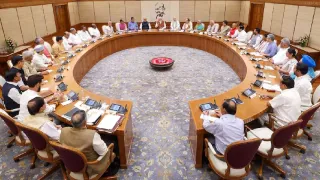
Ahead of the special Parliament sittings, Prime Minister Narendra Modi held a Union Cabinet meet at Sewa Teerth, New Delhi on Friday. The Cabinet is learnt to have cleared a fresh delimitation-linked women's reservation bill, which is likely to be brought before the special sitting of Parliament beginning next week. The government approved a uniform 50% increase in the share of Lok Sabha seats, extending the freeze for 25 years on using the 1971 Census as the basis to determine the proportional strength of each State in the Lower House.
Govt Brings Some Amendents In Previous Bill: Report
News agency PTI, quoting sources, reported that the bill was brought before the special meeting of the Union Cabinet, which is learnt to have accorded its nod to the fresh bill with some amendments to ensure that no state loses its representation in the Lok Sabha in proportion to other states after delimitation.
The Cabinet meeting was convened at 1 pm to discuss the bill, which the government is keen to get passed in the special sitting of Parliament starting Monday. The bill was brought in Parliament by the government during a special sitting in April, but it could not pass muster in the Lok Sabha.
The development follows PM Modi's assertion on Thursday that no force can stop the delivery of justice to women, as he blamed "one opposition party" for the defeat in Parliament of the delimitation-linked Constitution (131st Amendment) Bill, 2026, which gives 33 per cent reservation to women in legislatures, in April.
Govt Appeals To MPs To Ensure Smooth Special Sitting Of Parliament
Meanwhile, Parliamentary Affairs Minister Kiren Rijiju on Friday appealed to all MPs to ensure a smooth special sitting of Parliament that will discuss "very important bills." The Union minister said it is a joint responsibility of all members to ensure that the world''s largest parliamentary democracy, India, sets an example.
"My appeal to the members of Parliament is to ensure that Parliament functions smoothly. We are proud of our democracy, and we must ensure that Parliament functions smoothly," he told reporters in New Delhi.
Rijiju said the government has called for a four-day special sitting -- November 30 and December 1 in Lok Sabha, and December 2 and 3 in Rajya Sabha.
"When the government calls a session or a special session, that means there are very important bills or business for the nation," he said.
The minister said the members of Parliament have a very special task, an onerous responsibility, in ensuring a smooth run of Parliament.
"Members have all the rights, all the freedom to agree or to disagree. But that has to be put in proper perspective through rules, through conventions on the floor of the House," he said.
Govt's Renewal Push For Delimitation
The special sitting was announced on Thursday to transact "essential" business, amid indications that the government may reintroduce a constitutional amendment linking the rollout of women's reservation to delimitation.
The government has been keen to push through the Constitution amendment bill for a long time. It seeks to expand the Lok Sabha's strength from the existing 543 seats to a maximum of 850 through delimitation. The treasury benches have said it will pave the way for the implementation of 33 per cent reservation for women in Parliament and state legislatures ahead of the 2029 general election.
The government's earlier move to pass the proposed legislation in Parliament was defeated in April due to a lack of numbers.
The Constitution Amendment Bill to implement reservation for women in legislatures in 2029 and increase the number of seats of the Lok Sabha was defeated in April in the Lower House. While 298 members voted in support of the Bill, 230 MPs voted against it. Out of 528 members who voted, the Bill required 352 votes for a two-thirds majority.
(With Agencies Inputs)