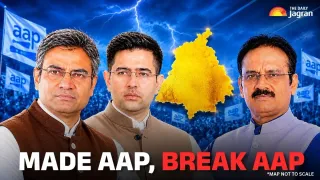
Punjab Elections 2027: In the 2022 Punjab Assembly elections, they helped build the campaign that gave the Aam Aadmi Party (AAP) a historic victory, winning 92 of the state's 117 seats. Four years later, the same leaders will help the BJP challenge the government they once helped bring to power.
The Punjab BJP on Sunday appointed former AAP leaders Raghav Chadha and Sandeep Pathak to two key committees ahead of the 2027 Assembly elections. While Chadha has been named to the manifesto committee, which will draft the party's poll promises, Pathak will be part of the chargesheet committee, tasked with highlighting the failures of the Bhagwant Mann government.
Punjab BJP president Kewal Singh Dhillon constituted the two committees, bringing together former leaders from the AAP and Congress. Other prominent names include former cricketer Harbhajan Singh, businessman Ashok Mittal and former Punjab Congress chief Sunil Jakhar, who will head the chargesheet committee.
This is more than a development of political defections. It marks a major role reversal, with the leaders who helped script AAP's 2022 Punjab victory now preparing to challenge the party ahead of the next Assembly elections.
Ex-AAP Strategists Who Scripted 2022 Punjab Landslide Gets Key BJP Roles
In 2022, Sandeep Pathak was AAP's Punjab in-charge. While he was not the public face of the campaign, he played a key role in building the party's election machinery. An IIT-Delhi faculty member, Pathak was often described as AAP's 'Chanakya'.
Pathak helped build the party's booth-level volunteer network, door-to-door campaign and data-driven war room, which tracked developments across constituencies.
He had been working for the party "behind the scenes" for several years and had built "the entire organisation cadre" in Punjab, according to AAP party members, PTI reported.
Pathak spent nearly two years in Punjab before the 2022 elections, working to strengthen a state unit that was struggling with internal differences following its 2017 poll defeat. He reorganised the party's cadre down to the village and booth levels, creating a network of local workers.
Raghav Chadha, meanwhile, was AAP's Punjab co-incharge and one of the campaign's most visible young faces after Arvind Kejriwal. He handled media outreach, connected with urban voters and young people, and acted as a link between the party's Delhi leadership and its workers in Punjab.
Together, the two leaders helped turn AAP's 'Delhi Model' of governance, which included free electricity, mohalla clinics and improvements in government schools into a major election promise in Punjab.
ALSO READ: BJP Assigns Key 2027 Punjab Poll Roles To Former AAP Leaders Raghav Chadha, Sandeep Pathak
The campaign focused on promising better governance, presenting Delhi as an example and building a strong network of volunteers across villages.
The strategy paid off. AAP won 92 of the 117 Assembly seats, while the Congress was reduced to 18. The Shiromani Akali Dal-BSP alliance won four seats, and the BJP managed just two.
What They Built, They Will Now Challenge
Four years later, Pathak and Chadha have taken up roles that put them on the opposite side of the party they once helped build.
Pathak is now part of the chargesheet committee headed by former Punjab BJP chief Sunil Jakhar. The panel will prepare the BJP's case against the Bhagwant Mann government by highlighting its alleged failures.
Chadha, on the other hand, has been appointed to the manifesto committee headed by former state BJP president Avinash Rai Khanna. He will help draft the BJP's promises for the 2027 elections, which will be presented as an alternative to the promises he once helped AAP make to voters.
The 13-member manifesto committee will have Chadha as one of its members, while Pathak will work with the 14-member chargesheet committee.
In April 2026, Chadha led a group of AAP Rajya Sabha MPs who joined the BJP. The group included Sandeep Pathak, Ashok Kumar Mittal, Harbhajan Singh, Vikramjit Singh Sahney, Rajinder Gupta and Swati Maliwal.
Six of the seven Rajya Sabha MPs who left AAP in April 2026 have now been given key responsibilities in the BJP's Punjab election committees.
BJP's Punjab Game: Why It Needs AAP's Former Leaders
The BJP's strategy appears to have two clear parts, which are to challenge the Mann government's record and present voters with an alternative.
For the BJP, bringing former AAP strategists into its election planning could offer an advantage. Pathak understands the party's organisational structure, volunteer network and campaign machinery. He also has experience working at the grassroots level and could help the BJP identify gaps between AAP's promises and their implementation.
Chadha, meanwhile, understands how AAP frames its political messaging and connects with voters. His experience could help the BJP counter the party's campaign narrative.
The BJP is also holding talks with the Shiromani Akali Dal over a possible alliance
Who Will Chair What?
Former Punjab BJP president and ex-MP Avinash Rai Khanna will head the manifesto committee. Its 12 other members are Manpreet Singh Badal, Ashwani Sharma, Manoranjan Kalia, Som Parkash, Rana Gurmit Singh Sodhi, Ashwani Sekhri, Satnam Singh Sandhu, Raghav Chadha, Rajinder Gupta, Harbhajan Singh, Parampal Kaur and HS Phoolka.
Former Punjab BJP chief and ex-MP Sunil Jakhar will head the chargesheet committee. Its 13 other members are Iqbal Singh Lalpura, Vijay Sampla, Shwait Malik, Preneet Kaur, Ravneet Singh Bittu, Dinesh Babbu, Sushil Rinku, Gejja Ram, Vikramjit Singh Sahney, Ashok Mittal, Sandeep Pathak, SS Channi and Jagmeet Singh Brar.
The chargesheet committee will focus on issues such as employment, drugs, law and order and the implementation of AAP's election guarantees. Pathak's experience within the party could help the BJP understand its internal functioning and identify areas where it can target the government.
The manifesto committee, meanwhile, will have to prepare promises that appeal to Punjab's voters. Chadha's experience in selling AAP's 2022 promises could help the BJP understand which issues connected with voters and how the party can frame its own campaign.