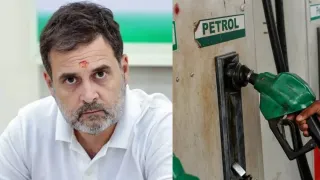
Congress leader Rahul Gandhi, on Saturday, criticised the Modi government regarding the rollout of E20 petrol, citing test results of fuel samples collected by the Karnataka government. He urged the Centre to provide transparency regarding the actual ethanol content in fuel sold nationwide. In a post on X, Gandhi stated that "E20 turned into 420", alleging that petrol was being stolen from public vehicles, referencing Section 420 of the former Indian Penal Code concerning cheating.
He noted that while the government claims petrol contains 20 per cent ethanol, accredited lab tests on samples from seven Karnataka districts revealed significantly higher levels. Specifically, he claimed that 11 of 14 samples exceeded the 20 per cent threshold, reaching up to 31.2 per cent at IOCL and 30.5 per cent at HPCL, with both public and private suppliers—including IOCL, HPCL, BPCL, Nayara, and Shell—exceeding the prescribed limit.
11 Out Of 14 Samples Exceeded Standard Ethanol Concentrations
Petrol sold in seven districts of Karnataka contained ethanol concentrations as high as 31.2 per cent, with eleven of 14 samples exceeding the 20 per cent blend specified under the E20 standard, according to the state government. The Centre claimed the highest concentration was recorded in a sample collected from an Indian Oil Corporation Limited (IOCL) outlet, containing 31.2 per cent ethanol. A sample of Hindustan Petroleum Corporation Limited (HPCL)’s Power petrol had 30.5 per cent, while another sample from the company recorded 27 per cent and a BPCL Speed sample contained 26.5%, it added.
Where were the samples collected from?
The samples were collected from fuel stations in Bengaluru, Kolar, Chikkaballapura, Bengaluru Rural, Ramanagara, Mangaluru and Tumakuru, covering IOCL, HPCL, BPCL, Nayara Energy, Shell and Mangalore Refinery and Petrochemicals Limited, according to a state government statement.
The statement said testing was conducted at the Shriram Research Institute in Bengaluru, measuring ethanol content using gas chromatography. It added that the results showed substantial differences not only between companies but also among samples from the same company.
Companies rejected the findings
The three state-run oil companies, including IOCL, BPCL and HPCL, disputed the findings in a joint statement on Friday. The oil companies claimed the reports “are not supported by testing" conducted as per the prescribed statutory and technical procedures”. The three organisations alleged that the E20 they supply across the country, including in Karnataka, conforms to IS 17021, the Bureau of Indian Standards specification for ethanol-blended petrol.
They further added that all the 893 E20 samples tested from their depots and outlets in 27 states and union territories were under the prescribed range of 19-21 per cent ethanol. These tests included 56 from Karnataka, which reportedly stood between 19 per cent and 20 per cent, with an average of 19.30 per cent.
What were the variations in the samples?
As per the statements, two IOCL samples recorded ethanol concentrations of 31.2 per cent and 20.8 per cent. It claimed that the BPCL samples ranged from 19.9 per cent to 26.5 per cent, while Shell samples recorded 13.5 per cent and 25.5 per cent. The statement said that across all 14 samples, 11 exceeded 20 per cent; the remaining three were below that level, including one at 19.9 per cent.
The Centre claimed it initially sent samples to the in-house laboratories of IOCL and BPCL. “The test reports issued by these laboratories did not disclose the ethanol content of the fuel, despite it being one of the prescribed testing parameters,” the statement added. The state then commissioned independent testing at the Shriram Research Institute. The laboratory certificates attached to the statement record the ethanol concentrations in the samples, including 31.2% in an IOCL sample and 30.5 per cent in an HPCL Power sample.
The government said the omission in the oil companies’ reports raised questions about transparency in fuel marketing. It added that the laboratory findings establish the ethanol content of the samples tested. They do not, by themselves, establish how widespread such concentrations are across the state’s fuel supply, the statement said.The state subsequently commissioned independent testing at the Shriram Research Institute. The resulting laboratory certificates documented ethanol concentrations of up to 31.2 per cent in an IOCL sample and 30.5 per cent in HPCL Power petrol.
Government officials noted that omissions in the oil companies' initial reports raised transparency concerns regarding fuel marketing. While these independent findings confirm high ethanol levels in the tested samples, they do not determine how widespread such concentrations are across the state's overall fuel supply.