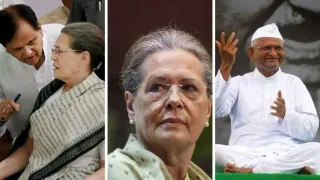
Following the release of former Congress president Sonia Gandhi's memoir, Belonging: A Journey of Love, an error has come to light regarding the death of her close aide Ahmed Patel. The book incorrectly mentions 2022 as the year of his death. Patel, who was 71, died in November 2020, two years earlier than the date mentioned in the memoir.
In the book, Sonia Gandhi recalls Patel's role in her political journey. She writes that he continued to serve as her political secretary until he died of Covid-19 in 2022. She also says his death left a big gap in the Congress and that she personally felt his absence deeply. The passage appears on page 401.
( image credits: social media )
However, Patel died on November 25, 2020, after testing positive for Covid-19 on October 1 that year. He was admitted to the intensive care unit of Medanta Hospital in Gurugram on November 15, ten days before his death.
Patel was one of Sonia Gandhi's closest aides and played an important role in advising her on party matters, political alliances and organisational issues. Along with senior leaders such as Ambika Soni and Madhavrao Scindia, he was among the political colleagues she turned to during her early years in public life.
ALSO READ: Pranab Mukherjee's Daughter Questions Sonia Gandhi's 'Shock' Over Father's PM Ambition
Anna Hazare movement's year mentioned incorrectly
Another factual error in Sonia Gandhi's memoir has been pointed out by Ajit Anjum, an award-winning Indian journalist, writer and digital commentator known for his long career in Hindi television news and independent digital journalism.
On page 461 of Belonging: A Journey of Love, Sonia Gandhi mentions 2012 as the year when social activist Anna Hazare emerged as the face of the India Against Corruption movement.
The book states, “In 2012 a well-known activist from Maharashtra, Baburao ‘Anna’ … Hazare, emerged as the figurehead of a movement that titled itself ‘India Against Corruption.’”
It also describes how Hazare was brought to Delhi to begin a hunger strike demanding the appointment of a Lokpal to investigate corruption cases.
However, the year mentioned in the memoir is incorrect. Anna Hazare began his indefinite hunger strike at Jantar Mantar in New Delhi on April 5, 2011. Another major phase of the movement took place in August 2011, when he went on a hunger strike at Ramlila Maidan.
Anjum pointed out the year-related error and described it as a minor but notable mistake in an otherwise ambitious book. He also highlighted the importance of editors and fact-checkers in identifying such errors before publication.
In a post on X, Anjum also shared Sonia Gandhi's account of the Anna Hazare movement, in which she alleged that the RSS and BJP were behind it.
In the memoir, Sonia Gandhi writes:
"'The RSS and BJP were behind the Anna movement'
Sonia Gandhi wrote in her book: Anna Hazare, a well-known social activist from Maharashtra, emerged as the face of a movement that called itself 'India Against Corruption'. Some of the movement's key participants later claimed that it had been secretly organized and supported by the BJP and the RSS. Anna Hazare was brought to Delhi amid a massive publicity campaign so that he could begin a hunger strike. His demand was that an ombudsman be appointed with sweeping powers to investigate corruption cases. Large numbers of people joined the movement, and we found ourselves on the back foot. We were unable to counter the BJP's aggressive campaign. We introduced the Lokpal Bill in 2014. It gave the Lokpal at the Centre and Lokayuktas in the states the authority to investigate corruption cases against government officials, but under BJP rule, the law gradually faded into obscurity. The Lokpal became a toothless tiger, almost invisible. And once our political opponents had achieved their real objective—ousting our government from power—there was neither any news nor any writing about Anna Hazare. Behind the scenes, the RSS was laying the groundwork to put forward a new candidate for prime minister. That candidate was Gujarat's then chief minister, Narendra Modi."
ALSO READ: BJP Calls Sonia Gandhi's Memoir An Attempt To 'Whitewash Congress' Historical Wrongs'
BJP questions Sonia Gandhi's account of 1984 anti-Sikh violence.
In another issue related to the memoir, BJP leader and senior advocate HS Phoolka has questioned Sonia Gandhi's account of the 1984 anti-Sikh violence and Operation Blue Star in Belonging: A Journey of Love. He has alleged that some details in the book do not match official records and historical documents.
Phoolka has questioned Sonia Gandhi's account of when the Army was called in after Indira Gandhi's assassination. He has also disagreed with her description of the former prime minister's emotional reaction to Operation Blue Star.
Following the release of former Congress president Sonia Gandhi's memoir, Belonging: A Journey of Love, an error has come to light regarding the death of her close aide Ahmed Patel. The book incorrectly mentions 2022 as the year of his death. Patel, who was 71, died in November 2020, two years earlier than the date mentioned in the memoir. In the book, Sonia Gandhi recalls Patel's role in her political journey. She writes that he continued to serve as her political secretary until he died of Covid-19 in 2022. She also says his death left a big gap in the Congress and that she personally felt his absence deeply. The passage appears on page 401. However, Patel died on November 25, 2020, after testing positive for Covid-19 on October 1 that year. He was admitted to the intensive care unit of Medanta Hospital in Gurugram on November 15, ten days before his death. Patel was one of Sonia Gandhi's closest aides and played an important role in advising her on party matters, political alliances and organisational issues. Along with senior leaders such as Ambika Soni and Madhavrao Scindia, he was among the political colleagues she turned to during her early years in public life. BJP questions Sonia Gandhi's account of 1984 anti-Sikh violence. In another issue related to the memoir, BJP leader and senior advocate HS Phoolka has questioned Sonia Gandhi's account of the 1984 anti-Sikh violence and Operation Blue Star in Belonging: A Journey of Love. He has alleged that some details in the book do not match official records and historical documents. Phoolka has questioned Sonia Gandhi's account of when the Army was called in after Indira Gandhi's assassination. He has also disagreed with her description of the former prime minister's emotional reaction to Operation Blue Star. Speaking to news agency ANI, Phoolka said several media organisations had contacted him for his response to Sonia Gandhi's claim that the Army was called in on October 31, 1984, the day then Prime Minister Indira Gandhi was assassinated. "I got several phone calls from the media. They said Sonia Gandhi has written that during the 1984 Sikh massacre, the army was called on 31st October itself. I have purchased the book to read; this is indeed written in the book. If this is written in the book, it is against the records. It is absolutely false," Phoolka told ANI. Citing the Misra Commission's findings, Phoolka said the army was formally called in only on the evening of November 1 and reached the affected areas in large numbers on November 2. He also referred to the commission's observations about the army personnel available in Delhi during the violence. "The Misra Commission stated that 5,000 army personnel were available within Delhi, and they were not deployed. The Misra Commission stated that had they been deployed, the lives of 2,000 Sikhs could have been saved," he said. According to the Misra Commission, an additional army brigade of around 1,600 personnel had reached Delhi from Meerut before midnight on October 31, 1984. However, the Delhi administration delayed formally asking the army for help. The army began operations in parts of central and south Delhi by the evening of November 1. Five more brigades reached the city on November 2. The commission also observed that deploying around 5,000 Army personnel available in Delhi on the morning of November 1 could have prevented at least 2,000 deaths. Citing the Misra Commission's findings, Phoolka said the army was formally called in only on the evening of November 1 and reached the affected areas in large numbers on November 2. He also referred to the commission's observations about the army personnel available in Delhi during the violence. "The Misra Commission stated that 5,000 army personnel were available within Delhi, and they were not deployed. The Misra Commission stated that had they been deployed, the lives of 2,000 Sikhs could have been saved," he said. According to the Misra Commission, an additional army brigade of around 1,600 personnel had reached Delhi from Meerut before midnight on October 31, 1984. However, the Delhi administration delayed formally asking the army for help. The army began operations in parts of central and south Delhi by the evening of November 1. Five more brigades reached the city on November 2. The commission also observed that deploying around 5,000 Army personnel available in Delhi on the morning of November 1 could have prevented at least 2,000 deaths. Ahmed Patel's role in Congress Rajya Sabha MP from Gujarat, Ahmed Patel, was popularly known as 'AP' within the Congress. He had also served as an adviser to former Prime Minister Rajiv Gandhi. His political career began at a young age. In 1977, then Prime Minister Indira Gandhi selected him to contest the Lok Sabha election from Bharuch in Gujarat. He was just 28 at the time. Despite his strong influence in the Congress, Patel preferred to stay away from government positions and work behind the scenes. He became one of Sonia Gandhi's most trusted political advisers and helped her handle alliance talks, political disagreements and problems within the party. In her memoir, Sonia Gandhi writes at length about Patel's importance to the Congress and his role in helping her manage party affairs. "A loyal party colleague, approachable day and night, he came to play an important role as a troubleshooter, ready to listen patiently to disgruntled colleagues. Deeply religious but secular to the core in his politics, he kept a low profile while functioning as a coordinator between our party and our allies," she writes. She also describes Patel as a leader who had strong connections across political parties but could be tough on those who went against him. The 502-page memoir covers Sonia Gandhi's life, from her childhood in Italy and her years in the UK to her meeting with Rajiv Gandhi, her move to India and her entry into politics. The book also contains family photographs, including pictures of her parents, siblings and moments with her late husband.
Speaking to news agency ANI, Phoolka said several media organisations had contacted him for his response to Sonia Gandhi's claim that the Army was called in on October 31, 1984, the day then Prime Minister Indira Gandhi was assassinated.
"I got several phone calls from the media. They said Sonia Gandhi has written that during the 1984 Sikh massacre, the army was called on 31st October itself. I have purchased the book to read; this is indeed written in the book. If this is written in the book, it is against the records. It is absolutely false," Phoolka told ANI.
Citing the Misra Commission's findings, Phoolka said the army was formally called in only on the evening of November 1 and reached the affected areas in large numbers on November 2.
He also referred to the commission's observations about the army personnel available in Delhi during the violence.
"The Misra Commission stated that 5,000 army personnel were available within Delhi, and they were not deployed. The Misra Commission stated that had they been deployed, the lives of 2,000 Sikhs could have been saved," he said.
According to the Misra Commission, an additional army brigade of around 1,600 personnel had reached Delhi from Meerut before midnight on October 31, 1984.
However, the Delhi administration delayed formally asking the army for help. The army began operations in parts of central and south Delhi by the evening of November 1. Five more brigades reached the city on November 2.
The commission also observed that deploying around 5,000 Army personnel available in Delhi on the morning of November 1 could have prevented at least 2,000 deaths.
Ahmed Patel's role in Congress
Rajya Sabha MP from Gujarat, Ahmed Patel, was popularly known as 'AP' within the Congress. He had also served as an adviser to former Prime Minister Rajiv Gandhi.
His political career began at a young age. In 1977, then Prime Minister Indira Gandhi selected him to contest the Lok Sabha election from Bharuch in Gujarat. He was just 28 at the time.
Despite his strong influence in the Congress, Patel preferred to stay away from government positions and work behind the scenes. He became one of Sonia Gandhi's most trusted political advisers and helped her handle alliance talks, political disagreements and problems within the party.
In her memoir, Sonia Gandhi writes at length about Patel's importance to the Congress and his role in helping her manage party affairs.
"A loyal party colleague, approachable day and night, he came to play an important role as a troubleshooter, ready to listen patiently to disgruntled colleagues. Deeply religious but secular to the core in his politics, he kept a low profile while functioning as a coordinator between our party and our allies," she writes.
She also describes Patel as a leader who had strong connections across political parties but could be tough on those who went against him.
The 502-page memoir covers Sonia Gandhi's life, from her childhood in Italy and her years in the UK to her meeting with Rajiv Gandhi, her move to India and her entry into politics.
The book also contains family photographs, including pictures of her parents, siblings and moments with her late husband.