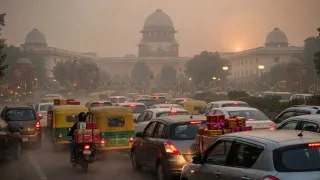
The Supreme Court has turned its focus to rising vehicular pollution amid worsening air quality in Delhi-NCR, directing the three neighbouring states to explain how they enforce emission standards, including regulation of vehicle entry and their plying. The top court also asked these states to explain how they keep polluting vehicles off the roads.
A bench led by Chief Justice Surya Kant, including Justices Joymalya Bagchi and V Mohana, in an order released on Sunday, sought detailed responses from the governments of Haryana, Rajasthan and Uttar Pradesh along with the Municipal Corporation of Delhi (MCD), the Delhi government, and Delhi Police's traffic department.
The parties have been asked to file responses on the regulatory framework governing commercial and non-commercial vehicles plying in Delhi-National Capital Region (NCR).
The apex court has ordered the authorities to disclose the mechanisms used to identify and regulate vehicles that do not conform to prescribed emission standards. This includes enforcement of Pollution Under Control Certification (PUCC) requirements.
The CJI-led bench directed them to include the steps taken to prevent the entry and operation of overage, end-of-life and non-compliant vehicles in their detailed responses.
ALSO READ: Anti-Smog Guns Deployed As Delhi Wakes Up To Toxic Air After Diwali Celebrations; How It Works
Apart from standards and mechanisms, the court also sought a response on actions. The top court has directed the authorities to put on record the number of vehicles inspected, challans issued, and denied entry due to violations.
The court has also asked for details on coordination between the three states and the Delhi government.
The questions would explore the problem of pollution in the national capital region. Besides, the court has also asked the authorities to submit detailed short-term and long-term measures to curb vehicular emissions. The Supreme Court also asked them to present a time-bound roadmap for strengthening enforcement of such measures.
The fresh directions on vehicular pollution came after the Commission for Air Quality Management (CAQM) had submitted a report to the top court, identifying vehicular pollution emissions as the single-largest contributor to air pollution in Delhi-NCR. Its share remains 23 per cent in winter and 19 per cent in summer.
During an earlier hearing, amicus curiae Aparajita Singh along with additional solicitor general Aishwarya Bhati placed an assessment of the compliance of the Graded Response Action Plan (GRAP). The data showed a sharp decline in stubble burning cases in these states between October 21 and November 3. However, the vehicular emissions were on a sharp rise, prompting the court to identify it as an 'equally pressing concern.'
ALSO READ: Escaping Delhi's Pollution? 5 Things To Check Before Booking Your Next Trip
"While this development is certainly laudable, the same data also brings to the fore a converse and equally pressing concern, namely, the sharp increase in issues attributable to vehicular emissions," said the bench.