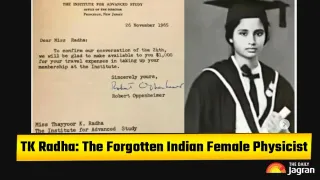
At a time when women had limited educational opportunities, TK Radha became a remarkable chapter in the history of India. She built a strong career in theoretical physics, which earned her an invitation from the father of the atomic bomb, J. Robert Oppenheimer. Radha began her journey after moving to Chennai from Kerala, and then to Stanford University and eventually to Princeton. After noticing her exceptional skills, Robert Oppenheimer invited her to join the Institute for Advanced Study in 1965.
One of the most prominent pioneers in the field, TK Radha's journey in theoretical physics remained forgotten for decades. It is only recently that archival research has brought her inspiring story back to light.
Who Was TK Radha?
Thayyoor K. Radha, also known as TK Radha, was an Indian theoretical physicist who became one of the elite people associated with the Institute for Advanced Study (IAS) in Princeton. She specialised in theoretical and high-energy particle physics. During the 1960s, Radha conducted her research involving nuclear physics, particle interactions, weak interactions, and quantum theory. In India, when women had the least representation in the field of advanced scientific research, TK Radha rose above the odds to become a trailblazer.
From A Village In Kerala To The World Of Physics
Radha was born in Thayyoor, a village in Kerala. Exceptionally good at Mathematics, she, however, did not limit herself to the subject. Rather, she chose Physics, which shaped her future career. Eventually, she moved to Chennai and got admission to the Presidency College, one of the country's prominent institutions at that time.
Later, she went on to publish 14 research papers on complex subjects, including Feynman propagators and particle interactions. Due to her extraordinary work in physics, she came into contact with leading scientists, including Freeman Dyson and Sergio Fubini, during her time at the institute. In 1965, her scientific journey caught the attention of J. Robert Oppenheimer, who was heading the Institute of Advanced Study and was famously known as the father of the atomic bomb.
She Reinvented Herself Through Computers
Her scientific journey came to a halt after she moved to Canada. Due to a lack of childcare, it became difficult for her to pursue theoretical physics while raising her family. Years later, in 1973, she started taking computer courses at the University of Alberta, making her comeback to education. As always, she excelled and finished at the top of the class. Her combined knowledge of physics and computing ability made her extremely valuable.
Over the next 16 years, Radha used her computer skills and physics knowledge to handle major projects and became an integral part of the university. Her career journey reflected how well she handled challenges while navigating a completely different field using her scientific training.