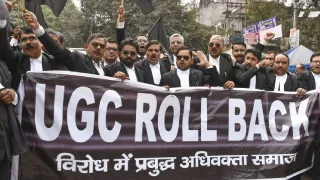
The government on Thursday told the Supreme Court that it was looking at ways to address students’ concerns over the UGC's 2026 Regulations. Solicitor General (SGI) Tushar Mehta submitted before a bench headed by Chief Justice of India (CJI) Surya Kant that the government wants to ensure that no group feels excluded, threatened or apprehensive under the framework. The develoment came after several student groups protested the new UGC regulations.
Special Committee To Re-Examine UGC’s 2026 Regulations
The Centre has informed the top court that it is setting up a special committee to re-examine the UGC’s 2026 regulations on promoting equity in higher education institutions, whose implementation was stayed by the court in January. The Solicitor General (SGI) said the government was looking at ways to address students’ concerns and ensure that no group feels excluded.
The CJI said the exercise must safeguard the interests of all students and emphasised that the concerns and well-being of the younger generation should remain central.
SC Terms UGC Guidelines Vague
Earlier, the top court had stayed the 2026 regulations after raising concerns that their provisions were prima facie vague and could be misused. It had directed that the 2012 UGC equity regulations would continue to apply until further consideration. While staying the 2026 UGC regulations in their entirety, a bench of the Chief Justice of India and Justice Joymalya Bagchi termed the language of the provision that defines "caste-based discrimination" as "vague".
ALSO READ: 'Torn Clothes, Threatened Naked Parade': Female Journalist Alleges Attack In DU Over Caste Identity
"There is complete vagueness in Regulation 3 (C), and it can be misused. The language needs to be re-modified," the Court remarked. The Court noted that for now, the 2012 UGC regulations will operate until it examines the validity of the 2026 regulations.
The bench, while acknowledging the submissions from the petitioners, stated that it may issue directions to the UGC to constitute a Committee, which should be approved by the Court, comprising academicians and eminent jurists who understand the functioning of educational institutions.
"Schools and colleges cannot exist in isolation or in a vacuum; they are an integral part of society", CJI Kant said. "How are people going to behave outside the campus if we create this kind of situation inside the campus?" the Court remarked.
Why Is There Protest Against Latest UGC Guidelines?
UGC (Promotion of Equity in Higher Education Institutions) Regulations, 2026, which was notified in January this year, triggered massive protests across the nation as several student groups termed it discriminatory. These regulations, introduced to curb caste-based discrimination in colleges and universities, require institutions to establish special committees and helplines to address complaints from students in the Scheduled Caste (SC), Scheduled Tribe (ST), and Other Backwards Classes (OBC) categories. The regulations define caste-based discrimination strictly as acts directed against members of the backward communities.
The upper-caste groups argued the rules were one-sided, omitted general-category protections, and lacked safeguards against false complaints.
Since the new norms were notified, a series of protests has been staged in several cities. Recently, hundreds of protesters demanding rollback of the UGC regulations blocked the Yamuna Expressway in Agra, leading to a scuffle and heated exchange with police. The protesters are demanding withdrawal of the UGC Regulations, 2026, alleging that some of its provisions could be misused against general-category students and lack adequate safeguards against false complaints.
(With ANI Inputs)