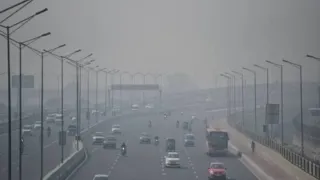
Uttar Pradesh's air pollution problem is spreading beyond its major cities, with smaller towns emerging as some of India's most polluted urban centres. Baraut in Baghpat recorded the country's highest monthly average PM2.5 concentration in October, while six UP cities featured in the national top 10, according to a new assessment by the Centre for Research on Energy and Clean Air (CREA).
Released on November 5, the assessment found that Baraut recorded an average PM2.5 level of 87 micrograms per cubic metre (µg/m³), followed by Khora in Ghaziabad at 85 µg/m³. Gajraula in Amroha ranked third.
Ghaziabad, Noida and Meerut were the other UP cities in the top 10. The state also had 13 cities recording monthly average PM2.5 levels above India's national daily standard of 60 µg/m³.
ALSO READ: Mumbai-Pune Old Highway To Get Six Lanes: Check Project Details, Timeline And Alternative Routes
The findings reflect a wider national crisis. Of the 267 Indian cities with sufficient monitoring data, 261 exceeded the World Health Organisation's daily PM2.5 guideline of 15 µg/m³ in October. Only six met the WHO benchmark.
Ghaziabad's Pollution Levels Rise
The challenge is not limited to the winter pollution peak. Ghaziabad's average PM10 concentration between January and August 2026 rose to 205 µg/m³ from 137 µg/m³ during the same period in 2025. Its average PM2.5 level across four monitoring stations increased from 67 to 82 µg/m³.
The UP Pollution Control Board (UPPCB) has identified nine pollution hotspots for the 2026-27 winter season, including Sahibabad, Raj Nagar Extension, Loni, Indirapuram and Vasundhara-Vaishali.
These areas face industrial emissions, traffic congestion, road dust, construction activity and unpaved roads.
UPPCB regional officer Ankit Kumar said construction activity was contributing to dust pollution at newly identified hotspots. He said anti-smog machines and water sprinkling would be intensified, alongside regular monitoring and enforcement.
However, Ghaziabad-based environmentalist Sushil Raghav questioned the effectiveness of enforcement drives, saying pollution remained a concern throughout the year.
Pollution Travels Beyond City Limits
CREA's analysis of research covering 143 Indian cities estimated that 82-89 per cent of urban PM2.5 concentrations came from sources outside city boundaries. This highlights the limitations of relying solely on municipal-level interventions.
The report also called attention to the need for pollution-control measures targeting industrial emissions, power generation and residential sources, rather than focusing heavily on road dust.
The UP government has outlined measures covering road dust, construction and demolition, open biomass burning, vehicular emissions, industrial pollution and stubble management.
At an October 23 review meeting, Union Environment Ministry Secretary Narendra Bhooshan examined the state's winter preparedness. The review covered road redevelopment, traffic decongestion, electric buses, waste processing and industrial compliance.
The UPPCB has also developed a Dust Portal to monitor construction and demolition sites through sensors, cameras, self-assessments and field inspections.
Congress Targets UP Government
The findings triggered criticism from state Congress president Aradhana Mishra 'Mona', who accused the government of failing to address the pollution crisis.
"The fact that the country's three most polluted cities are in UP reflects the gravity of the situation," she said, demanding time-bound action.