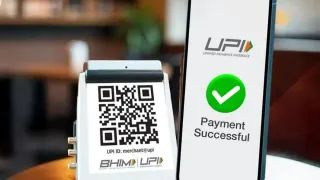
UPI MDR Row: The Supreme Court on Monday refused to stay the Centre's decision to impose the Merchant Discount Rate (MDR) on specified UPI person-to-merchant transactions above Rs 2000. Terming the issue "more technical and less legal", the top court, however, sought the government, RBI and NPCI's responses within four weeks on the plea challenging the UPI MDR.
The top court questioned the legal basis and the character of the newly-imposed charges and asked "who will ultimately receive the payments" and whether the charges can be considered a fee?
"What is the executive scope of making this expropriation? If not a fee, then what is the character of this charge?" a bench of Chief Justice of India (CJI) Surya Kant and Justices Joymalya Bagchi and V Mohana questioned.
The government earlier this month announced a 0.4 per cent fee on transfers worth more than Rs 2,000 made to merchants through UPI from October 15, ending nearly six years of fully free UPI payments. However, everyday person-to-person transactions and small payments are exempt from any charge.
"Customers will not be required to pay any charge when making such payments through UPI. MDR is a charge within the merchant payment ecosystem. It is not a charge on customers making UPI payments," the finance ministry said in a statement on September 15.
While detailing the UPI process during the hearing, the counsel appearing for respondent compared it with debit and credit card transactions, and said that multiple stakeholders are required to operate together, including the banks of the payer and recipient and the operators facilitating the payment ecosystem.
"Two banks, a coordinating agency, a payer, a recipient," the counsel said, adding that the service charge is essentially a mechanism for sharing the cost of providing that service.
The Court further asked whether the charges could be treated as a statutory levy or a charge arising from the payment service? Responding to the court, the counsel said that the NPCI merely facilitates the transactions and that no part of the amount is being taken by the Union government.
ALSO READ: UPI MDR: How 40:30:20:10 Split Works And Why Consumers Won't Pay
On who will receive the amount generated through the UPI transactions, the counsel said that the amount is received by the entities providing the two sides of the payment ecosystem -- the aggregator or the banks involved.
The Court has now sought an affidavit from the Central government addressing the questions raised during the hearing. Responses have also been sought from the RBI and NPCI on the nature and operation of the charges.
Who Will Pay MDR?
The merchant, not the customer. MDR will be charged within the merchant payment ecosystem, with banks and payment app providers sharing the commission.
How Much Will Be Charged?
A standard 0.4% MDR will apply to eligible UPI merchant payments above Rs 2,000, capped at Rs 300 for transactions of Rs 75,000 and above.
Which UPI Payments Will Attract MDR?
It applies to Person-to-Merchant (P2M) transactions above Rs 2,000. However, mutual funds, securities, stockbrokers and dealers will have a lower 0.02% MDR, capped at Rs 300.
Which Payments Will Remain Free?
Person-to-Person (P2P) transfers of any amount and P2M payments up to Rs 2,000 will remain free. There will also be no monthly quota or volume limit on free UPI transactions for individuals.
Are There Exemptions?
Yes. Railways, telecom, insurance, fuel and agricultural inputs will pay a flat Rs 5 MDR on transactions above Rs 2,000. The same Rs 5 treatment applies to government utility bills and educational fees. Small P2PM merchants receiving up to Rs 1 lakh/month through UPI QR will continue to pay zero MDR.