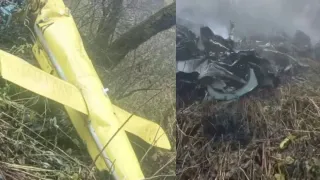
A helicopter carrying six people, including the pilot, crashed near Chai village in Uttarakhand’s Chamoli district on Friday, October 30, killing everyone on board. The Trans Bharat Aviation helicopter was flying from Badrinath to Dehradun when it crashed into a hillside near the Joshimath valley.
The crash has renewed concerns over helicopter safety on the Char Dham routes, where difficult terrain and rapidly changing weather pose challenges. Questions have also emerged over the sharing of accident investigation findings with the Uttarakhand government.
The Aircraft Accident Investigation Bureau (AAIB) is investigating the crash, while the Directorate General of Civil Aviation (DGCA) has sent a team for a preliminary regulatory assessment.
Why Are Helicopter Routes In Uttarakhand Difficult To Navigate?
Helicopters operating on the Char Dham circuit fly through mountainous terrain, where sudden cloud cover, rain and strong winds can affect visibility. Narrow valleys also leave pilots with limited room to manoeuvre.
Heat and humidity can further reduce a helicopter's lifting capacity by affecting the power available to the aircraft.
Flight hours are limited, with most flights taking place from sunrise until thirty minutes prior to sunset. All operators are given certain time windows to be able to handle the air traffic.
The India Meteorological Department (IMD) had issued an orange alert for Chamoli on Friday that indicated thunderstorms, lightning, hail and gusty winds in isolated areas. The reason behind the latest crash has not been determined.
Safety Rules For Char Dham Helicopter Service
The DGCA manages pilgrimage helicopter service through operational circulars. Its circular of February 2023 set route and altitude rules, while subsequent restrictions in 2025 and 2026 included weather alerts and minimum experience for pilots.
Key Safety Requirements Include:
- Weather monitoring: Operators must obtain regular weather updates for the departure point, route and destination.
- Diversion rules: Operators must have clear criteria for turning back or diverting when conditions become unsuitable.
- Pilot experience: Pilots must have experience in challenging weather and undergo scenario-based training for diversions and return-to-base decisions.
- Duty hours: Extensions to pilots' duty hours are not permitted during the monsoon.
- Familiarisation flights: Pilots new to the sector, or returning after a break of more than a year, must complete additional familiarisation flights.
For the 2026 pilgrimage season, pilots were also required to have at least 750 hours of hill-flying experience, including 100 hours in the preceding year, and 10 take-offs and landings at Kedarnath.
How Are Helicopter Movements Monitored?
The monitoring system involves multiple agencies. UCADA allots flying slots to operators, the Airports Authority of India (AAI) provides air traffic control, and the IMD supplies weather information.
For the 2026 pilgrimage season, AAI began providing air traffic control at Sahastradhara in Dehradun and Sersi in Rudraprayag district. Command centres at Sahastradhara and Sitapur monitored flights, helipads and weather conditions. Helicopters were also fitted with tracking devices.
Automatic weather stations equipped with ceilometers, which measure cloud-base height, were installed at Sitapur, Kedarnath, Badrinath, Jhala and Kharsali.
Helicopter Crash Investigation Reports
Despite tighter safety rules, the sharing of accident investigation findings with the Uttarakhand government remains a concern.
According to a Jagran.com report on helicopter accidents in the state, investigation findings from five accidents that occurred in 2025 had not been shared with the government. The report into the Kedarnath helicopter crash was reportedly provided to the state in August after pressure mounted for its release.
Uttarakhand has recorded 22 helicopter accidents since its formation, according to figures cited in Jagran.com. Of these, 11 accidents killed 56 people, while the remaining 11 caused no casualties.
The AAIB investigates aircraft accidents to determine the causes and submit recommendations on prevention. DGCA is the government body for aviation safety regulation and enforcement.
The state government and UCADA do not have direct responsibility for accident causation. However, access to the outcome of investigations can assist them in detecting safety-related lapses and establishing corrective safety measures.
ALSO READ: From Joshimath To Kedarnath, Inside Uttarakhand's Long History Of Helicopter Crashes
How Are Helicopter Operators Checked For Compliance?
The DGCA and UCADA carry out inspections, audits and operational surveillance to check that the measures are being adhered to. This includes the maintenance of aircraft, the qualification of pilots and flight records.
In 2025, the DGCA undertook special audits on eight helicopter operators serving high-altitude and rugged Himalayan areas. The audits revealed irregularities in monitoring of flight-duty-time, flight crew records related to execution of operational circulars, maintenance activities and slot allocation.
For the 2026 Char Dham season, DGCA teams were deployed at key helipads for surprise inspections and audits, while pilots' duty hours were monitored daily.
The latest crash has once again raised questions about the effectiveness of these safety measures and whether investigation findings are reaching the authorities responsible for managing helicopter operations in the state.