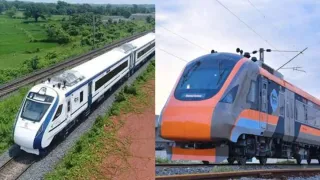
Indian Railways has introduced new-generation trains aimed at improving passenger comfort while reducing travel time. Among them, the Vande Bharat Express and Amrit Bharat Express have emerged as two prominent options, but they are designed for very different types of travellers.
While Vande Bharat focuses on premium, faster intercity travel, Amrit Bharat is aimed at providing comfortable long-distance travel at affordable fares. The two trains differ in their coaches, technology, speed, fares and passenger facilities.
1. Coaches: AC vs Non-AC
Vande Bharat is an air-conditioned train, with AC Chair Car and Executive Class coaches. Newer sleeper variants also include AC sleeper accommodation.
Amrit Bharat, on the other hand, is designed as a non-AC train. It primarily has sleeper and unreserved general coaches, making it more accessible to passengers looking for budget travel.
2. Different Propulsion Systems
Vande Bharat is a self-propelled trainset with traction motors fitted under the coaches, which can accelerate and decelerate rapidly without requiring a locomotive.
The Amrit Bharat train operates in a push-pull mode wherein a WAP-5 locomotive is attached at both ends of the train, with one at the rear pushing and one at the front pulling, to provide faster acceleration and avoid any jerky movement.
3. Speed And Fare
Vande Bharat is designed for faster intercity travel, with a maximum operating speed of 160 kmph on suitable routes. Its fares are considerably higher than conventional non-AC services and vary according to the route and class.
For example, on the New Delhi-Varanasi route, the Vande Bharat fare is around Rs 1,463 for AC Chair Car and Rs 2932 for Executive Class for an adult, depending on the service. In comparison, the Amrit Bharat service on the route offers non-AC Sleeper accommodation at a much lower fare.
Similarly, the Delhi-Darbhanga Amrit Bharat service has a Sleeper fare of around Rs 635 for the approximately 1,140-km journey, according to the current railway fare data.
This difference reflects the positioning of the two trains: Vande Bharat offers premium AC travel at a higher fare, while Amrit Bharat focuses on affordable long-distance travel in Sleeper and General Class.
4. Who Are They Designed For?
The two trains cater to different passenger groups.
Vande Bharat primarily serves passengers seeking faster, premium travel, including business travellers, professionals and those travelling between major cities.
Amrit Bharat is aimed more towards budget-conscious passengers, including migrant workers, labourers and families travelling over longer distances.
5. Catering And Passenger Facilities
Vande Bharat provides an enhanced customer experience, with on-board catering and a number of modern passenger amenities. Its features include automatic doors, charging points and other attractive new interiors for a comfortable journey.
Amrit Bharat offers crucial comfort at a comparatively lower fare. These trains will have coaches with charging points, bottle holders and space for snacks. Unlike Vande Bharat, it uses manual doors and does not offer the same level of on-board catering.
Vande Bharat Or Amrit Bharat: What's The Difference?
In simple terms, Vande Bharat is positioned as a faster, premium train for passengers willing to pay more for upgraded facilities, while Amrit Bharat focuses on affordable long-distance travel with modern basic amenities.
The choice between the two ultimately depends on the passenger's budget, journey length and preferred level of comfort.