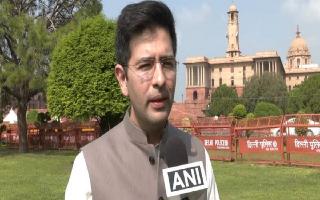
Aam Aadmi Party (AAP) leader Raghav Chadha on Friday reacted to the Supreme Court's decision that governors cannot keep bills pending indefinitely without any action and said that the Punjab Governor and Delhi LG need to read the apex order that made it clear that "unelected heads of state" cannot "misuse" their powers.
Taking to social media platform X, the AAP MP wrote, "The Hon'ble Supreme Court has given a verdict on a petition filed by the Punjab Government against the Punjab Governor. The verdict makes it clear that Governors are UNELECTED Heads of state and cannot MISUSE their powers to obstruct state legislatures."
"Perhaps the Governor of Punjab and LG of Delhi should read the said judgement as many times as needed to understand it and even seek the able assistance of a learned senior advocate if required," he added.
Earlier on Thursday, a Supreme Court bench headed by Chief Justice of India DY Chandrachud, "The Governor, as an unelected Head of State, is entrusted with certain constitutional powers. However, this power cannot be used to thwart the normal course of lawmaking by the state legislatures."
Besides CJI, the bench comprising J B Pardiwala and Manoj Misra passed the remarks while hearing a petition filed by the Punjab Government. The order was passed on November 10 and detailed judgement was made available today. On November 10, 2023, the court held the sessions of Vidhan Sabha, which were held on June 19, 20 and October 20, this year.
"Consequently, if the Governor decides to withhold assent under the substantive part of Article 200, the logical course of action is to pursue the course indicated in the first proviso of remitting the bill to the state legislature for reconsideration," the court ruled.
"In other words, the power to withhold assent under the substantive part of Article 200 must be read together with the consequential course of action to be adopted by the Governor under the first proviso. If the first proviso is not read in juxtaposition to the power to withhold assent conferred by the substantive part of Article 200, the Governor, as the unelected Head of State, would be in a position to virtually veto the functioning of the legislative domain by a duly elected legislature by simply declaring that assent is withheld without any further recourse," the court said.