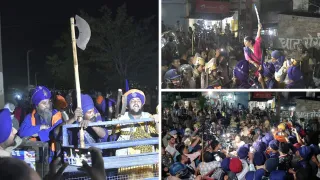
Ankur Agarwal | Dehradun: The Kulhal-Paonta border has become Uttarakhand's most volatile point following violent clashes between Nihangs and local police. The border area has been transformed into a virtual fortress, heavily monitored by police barricades, PAC deployment, and long queues of vehicles. The clash stems from June 16, when a dispute broke out between Nihang Sikh pilgrims returning from Sri Hemkund Sahib and local residents. It is alleged that the Nihangs attacked local residents with swords, leaving four people bleeding. Three Nihangs then fled on their bikes towards Gauchar, while one Nihang escaped with injuries.
Dehradun District Magistrate Dr Ashish Chauhan and Senior Superintendent of Police Pramod Doval were stationed at the border throughout the day. All vehicles were thoroughly checked, and every activity was monitored to prevent any probable escalation.
ALSO READ: Who Are Nihangs, The Warrior Saints Involved In Recent Uttarakhand Clash?
Traffic Affected
People traveling to Himachal Pradesh, Punjab, Haryana, Chandigarh, and Jammu and Kashmir were stuck in traffic jams for hours. Many buses arrived hours behind schedule. Commuters with private vehicles were forced to wait on the highway.
Administration Practiced Restraint
The administration maintained restraint throughout the incident, avoiding confrontation, but there was no laxity in security arrangements. Entry at the border was strictly controlled.
While efforts continued to find a solution through talks, the police gave clear indications that no person would be allowed to take the law into their own hands within the borders of Uttarakhand.
Who Are The Nihangs?
The word "Nihang" means "unaffected by pain or comfort, given to meditation, penance, and charity" and "complete warrior." The Nihangs are usually identified by their blue attire and dumalla turbans and use spears and swords as their primary weapons.
The weapons of the Nihangs are not simply ceremonial objects like those of other baptised Sikhs who carry a kirpan as part of the five Kakars. Traditional Sikh texts describe the Nihangs as warrior saints whose duty was to defend the faith, protect the vulnerable, and remain prepared for battle at all times. The weapons signify their vow to defend the weak, protect religious freedom, and uphold justice. They aren't meant to attack the unarmed.