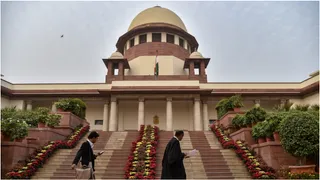
The Supreme Court on Thursday posed sharp questions to the central government regarding the appointment process for the Chief Election Commissioner (CEC) and Election Commissioners. The court said that if the selection committee is solely dominated by the government, it could raise questions about the independence of democratic institutions.
A bench headed by Justice Dipankar Datta was hearing the matter. During the hearing, the court asked if the Chief Justice of India (CJI) is included in the appointment committee of the CBI Director, then why there is no independent member in the appointment process of a crucial democratic institution like the Election Commission of India
"I was wondering. For a CBI director, CJI is there. We can say for the maintenance of law and order. Or you can stretch it to the rule of law also. But not for maintaining democracy? Not for ensuring pure elections?" Justice Dipankar Datta observed.
ALSO READ: NEET 2026 Exam Row: FAIMA Files Plea In Supreme Court To Dissolve NTA Over NEET UG Paper Leak
SC questions government’s dominance
The court also noted that under the current system, the selection committee comprises the Prime Minister, the Leader of the Opposition in the Lok Sabha, and a Union Minister. In the event of a disagreement between the Prime Minister and the Leader of the Opposition, the third member will side with the government.
"Why this show off of independence in the appointment of the election commissioner," the SC remarked while questioning the structure of the selection committee.
"We don't say CJI should be there. But why shouldn't there be an independent member? Why should it be from the ministry? Let us be very clear. Today, the Prime Minister picks one. And the Leader of the Opposition (LoP) picks another one. There is disagreement. The third member will go towards the LoP?" the judge asked.
Attorney General R Venkataramani responded to the judge’s query, saying he did not want to take a guess.
ALSO READ: Supreme Court Upholds Hindu Women’s Right To Seek Divorce After Separation, Dismisses PIL
"May not be in all practicality. I don't want to second-guess that," the Attorney General said.
The Attorney General’s remarks drew sharp observation from Justice Dutta, who said, "Then it is the executive who is controlling everything".
"What troubles us prima facie is why there is an executive veto? After all these precedents, was the parliament not aware of these cases? Parliament has the power to frame the laws. But the Supreme Court is the final arbiter. It will have the power to interpret the laws whether you like it or not," Justice Datta said.