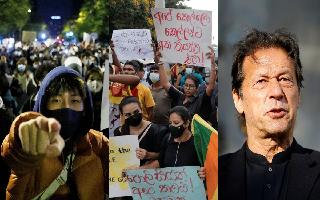
THE YEAR 2022, which proved to be a roller coaster ride for many economies globally, is coming to an end. From political melodramas to massive protests to wars, this year has witnessed them all. Apart from some newsworthy developments in the western part of the globe, the eastern part of the world, or let's just say India's neighbours including Afghanistan, Pakistan, Sri Lanka and China witnessed some high-voltage dramas ranging from economic crisis to removal of a prime minister to the worst-ever COVID outbreak.
While Sri Lanka faced its worst-ever economic crisis, Pakistan witnessed major political turmoil with the removal of Imran Khan as the Prime Minister. China, on the other hand, saw rare protests against the ruling Communist Party and Xi Jinping, who became the country's President for the 3rd time. The country also witnessed its worst-ever COVID outbreaks since the emergence of the deadly virus in 2019.
As the year draws close to its end, here is a quick rundown of some of the most significant developments that grabbed the world's attention in 2022:
China: This year, China has received applause from all around the world for lifting 60 per cent of its people out of poverty. Among the world's 15 most populous developing countries, China has seen the greatest drop in poverty rates. However, 2022 was a turbulent year for the nation after Chinese President Xi began his third term as general secretary of the Chinese Communist Party (CCP). Under the leadership of XI, Beijing has been reeling under economic stress due to the real estate crisis and zero-Covid policy.
In response to President Xi Jinping's strict zero-Covid policy, which has permitted authorities to keep millions of civilians under stringent lockdowns even if just a few cases are detected, hundreds of people have taken to the streets to protest. The country has experienced both a deteriorating coronavirus outbreak and anti-Zero COVID protests over the past several days. The most recent outbreak of unrest was mostly brought on by a deadly fire in a locked-down apartment complex in Xinjiang, an autonomous territory in northwest China.
A recent face-off between Indian and Chinese troops in the Tawang sector of Arunachal Pradesh on December 9 which led to injuries to soldiers, was another event that did not help the country to end the year on a good note.
Sri Lanka: Before the year ends, Sri Lanka is waiting for International Monetary Fund (IMF) to formally approve USD 2.9 billion bailout package. In 2022, the nation experienced a political, economic, and social crisis. According to Sri Lanka's local media outlet The Daily Mirror, the economic crisis in the island nation was caused by several years of mismanagement, corruption, shortsighted policymaking, and an overall lack of good governance.
Due to the island nation's reliance on its tourism industry, the COVID-19 pandemic exacerbated the economic problem. Notably, the economic crisis in Sri Lanka triggered widespread demonstrations that compelled the former president of Sri Lanka, Gotabaya Rajapaksa, to flee the country. The people of Sri Lanka demanded the resignation of President Gotabaya Rajapaksa and Prime Minister Mahinda Rajapaksa as they blamed their government for the mismanagement of the country's economy
Pakistan: This year, Pakistan has witnessed a political as well as a constitutional crisis. In the first week of April when National Assembly's Deputy Speaker Qasim Khan Suri dismissed a no-confidence motion against the then Prime Minister Iman Khan during a session, is where political turmoil emerged in the country. On April 10, the National Assembly passed a no-confidence motion against Imran Khan, making him the first Prime Minister to be dismissed through a no-confidence motion.
Following this, political unrest in the country was put to an end on April 11 when Shehbaz Sharif, the leader of the Pakistan Muslim League (Nawaz), took the oath of office as the 23rd Prime Minister of Pakistan. Apart from this, the country bore extensive destruction and damage due to devastating floods in Pakistan. In addition to this, the country suffered significant damage and destruction due to disastrous floods. Over 33 million people have been impacted by the floods in the country, which also claimed over 1,200 lives.
Afghanistan: One year ago, on August 15, 2021, the Taliban entered Afghanistan’s capital city of Kabul and took control of the country. Since then, the Taliban have been cracking down on women's rights and freedom despite initial promises that women would be allowed to exercise their rights within Sharia law. However, over time, human rights violations against women have mounted in Afghanistan. The Taliban has implemented several laws that have been violating women's health and education rights, curtailing their freedom of movement and expression.
Apart from this, the Taliban banned the cultivation, trafficking, and use of illicit narcotics in Afghanistan, the world’s biggest producer of opium. Opium is a key component in the production of the illegal narcotic heroin as well as the class of medically prescribed opioids, on which millions of people throughout the world rely for pain relief.
Nepal: The Himalayan country, which has had 30 governments in as many years, aroused concerns about instability with its general election on November 20. The elections were held to choose its eleventh administration since the nation's conversion to a democratic republic in 2008. However, Nepal's politics have been plagued by the ongoing formation and dissolution of alliances, which has left voters disappointed. The Election Committee has issued a notice announcing Sher Bahadur Deuba as the winner in today’s election for the leader of the parliamentary party.
Bangladesh: Last year in October, a Facebook post triggered widespread violence against the Hindu community in Bangladesh. A mob vandalized a Hindu temple in Cumilla. Several Durga pandals were vandalized, close to 150 families were attacked and at least three Hindus were reportedly killed in the violent clash.