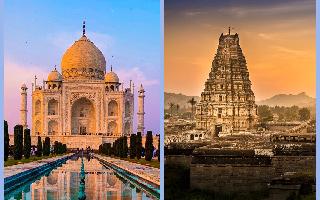
It is important to preserve the cultural heritage of a country as it shapes human society. India has 32 buildings that have been designated by UNESCO as World Heritage Sites, with 25 of them being of cultural significance and 7 being natural. India is one of 137 countries that are part of this decision.
Taj Mahal
The Agra Fort, a well-known structure constructed by the Mughals in 1573 and situated close to the Taj Mahal, is on the right bank of the River Yamuna. In 1983, it was designated a UNESCO World Heritage Site and given the name Red Fort of Agra.
Fatehpur Sikri
Emperor Akbar constructed Fatehpur Sikri in 1571 as a tribute to Sheikh Salim Chisti, and it remained the imperial capital for 15 years. In 1986, Fatehpur Sikri was added to India's list of UNESCO World Heritage Sites.
Ajanta Caves
The very famous Ajanta Caves are especially known for their 31 rock-cut Buddhist cave monuments, paintings, and sculptures built between the 2nd century BCE and 650 CE. The location was designated a UNESCO site in 1983 and is now looked after by the Indian Archaeological Survey. From Aurangabad, it is 101 kilometres away.
Also Read: May 2023: Important Holidays, Festivals, National And International Events To Keep In Mind
Chola Temple
The Chola dynasty erected beautiful temples during their reign, and the impressive and magnificent Chola temple in Thanjavur, with its opulent design and stunning architecture, was greatly influenced by Southeast Asian art.
Kaziranga National Park
In 1985, India's Kaziranga National Park was added to the UNESCO list of World Heritage Sites, making it a well-known natural region. It is unique in that it has thick forests, grasslands, lakes, and streams.
Mountain Railways Of India
India's mountain railways, such as the Darjeeling-Himalayan Railway in West Bengal, the Nilgiri Mountain Railways in Tamil Nadu, and the Kalka-Shimla Railway in Himachal Pradesh, showcase exceptional engineering skills used to create a train link across the highlands. These railways serve as an excellent example of extravagant engineering applied to the challenge of constructing railways in mountainous terrain.
Monuments Of Khajuraho
The monuments in Madhya Pradesh are remarkable examples of the Chandela Dynasty, which existed prior to the Mughal invasion. These monuments, with their breathtaking sculptures that boldly emphasise sensuality, are an essential part of India's history.
Mahabodhi Temple
The Mahabodhi Temple, an intricate Buddhist pilgrimage site, covers twelve acres of land in Bihar. It holds immense importance for the Buddhist religion as Lord Buddha attained enlightenment at this location.
Sun Temple
The Konark Sun Temple is on the east coast of the Bay of Bengal, 35 kilometres from Puri. It is a temple with Kalinga architecture from the 13th century. It is a colossal stone chariot with 24 wheels, enormous walls, and pillars that was created in honour of Surya, the Sun God.
Qutub Minar
In 1993, Qutub Minar and the surrounding monuments were added to India's list of UNESCO World Heritage Sites. It is one of the oldest buildings in the world, the highest brick minaret in the world, and a prime example of Islamic architecture. It is distinctive for its red sandstone and marble architecture, which features lovely carvings and decorations.