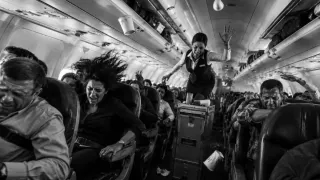
Imagine sitting comfortably at 35,000 feet. The sky outside is perfectly blue, there are no thunderstorms on the horizon, and the seat-belt sign is off. Suddenly, the aircraft drops or jolts violently. Passengers are thrown against their seats, cabin baggage shifts, and flight attendants rush to find something to hold on to.
There may be no cloud, storm, or visible warning.
This is clear-air turbulence (CAT), an invisible atmospheric phenomenon that has become an important concern for modern aviation. Turbulence itself is not unusual. Aircraft routinely encounter disturbed air, and commercial jets are designed to withstand substantial aerodynamic stresses.
But clear-air turbulence is particularly challenging because it can occur in apparently calm weather and cannot be detected visually by pilots in the same way as a thunderstorm or dense cloud. CAT is a high-altitude phenomenon associated particularly with strong wind shear around jet streams.
What exactly is clear-air turbulence?
Turbulence is essentially irregular movement of air. Instead of flowing smoothly, air moves in rapidly changing currents and eddies.
Clear-air turbulence usually develops at cruising altitudes, roughly between 20,000 and 50,000 feet, particularly in regions where there are sharp differences in wind speed and direction. One of the most important locations is around jet streams, narrow bands of very strong winds that race through the upper atmosphere.
When an aircraft crosses a region of strong wind shear, its flight can suddenly become bumpy. The changes may be brief and relatively mild, or they can be strong enough to cause injuries to passengers who are not securely strapped into their seats.
Importantly, CAT does not mean that an aircraft is about to crash. Modern airliners are engineered to operate safely through turbulence. The greater immediate danger is often to people inside the cabin.
Why is it so difficult to detect?
This is what makes clear-air turbulence particularly troublesome.
Thunderstorms and many other forms of severe weather can be identified using weather radar, satellite observations, and visual cues. Clear-air turbulence, by definition, may occur in air that looks completely clear. Pilots and meteorologists therefore rely on weather models, observations, reports from other aircraft, and sophisticated turbulence forecasting systems.
Pilot reports, known as PIREPs, are especially valuable. When crews encounter CAT, they can report its location and intensity, providing information that can help other aircraft avoid or prepare for the same region. The FAA notes that pilot reports remain an important source of information about CAT.
Modern forecasting is also becoming increasingly sophisticated. Aviation weather systems combine numerical weather prediction, aircraft observations, and other data to estimate areas where turbulence is likely to occur. Turbulence programs are working towards higher-resolution and globally expanded forecasting capabilities, including the use of artificial intelligence techniques in future systems.
What happens to an aircraft during severe turbulence?
An aircraft encountering turbulence can experience sudden changes in acceleration and altitude. Passengers may feel as if the aircraft has suddenly fallen, even when the actual vertical movement is much smaller than the sensation suggests. The aircraft may pitch, roll, or experience rapid changes in vertical acceleration.
For passengers, however, the biggest danger is often not the aircraft itself but being thrown around inside it. That is why aviation authorities repeatedly stress one simple precaution: keep your seat belt fastened whenever you are seated, even if the seat-belt sign is switched off.
Keeping seat belts fastened reduces the risk of injuries from unexpected turbulence. Flight attendants can be injured too. A crew member moving through the cabin when unexpected turbulence strikes has little opportunity to brace themselves.
Is turbulence becoming more common?
This is where the issue becomes particularly interesting. Scientists have been examining whether climate change could alter atmospheric conditions conducive to turbulence. Several studies indicate that a warming climate could increase turbulence in some regions and at some flight levels.
A 2023 study published in npj Climate and Atmospheric Science found projected increases in moderate-or-greater turbulence from several sources under climate-change scenarios, including clear-air turbulence, mountain-wave turbulence, and turbulence near clouds.
Another study published in Nature Climate Change found that the fastest upper-level jet-stream winds are projected to strengthen under climate change. The researchers noted that this could have implications for commercial flight times as well as clear-air turbulence.
But this does not mean that every flight will suddenly become dramatically bumpier because of global warming. The relationship is complex, varies geographically, and depends on atmospheric circulation patterns.
The important takeaway is that climate change could alter the atmospheric ingredients that contribute to turbulence, making accurate forecasting increasingly important.
Why are jet streams so important?
Jet streams are powerful currents of air several kilometres above Earth's surface. Commercial aircraft frequently fly near them because they can substantially influence flight duration and fuel consumption. But the boundary between a very fast-moving jet stream core and surrounding slower air can contain strong wind shear.
That is one of the classic environments for clear-air turbulence. For airlines, avoiding turbulence is therefore not simply a matter of passenger comfort. Flight planners and pilots must balance safety, fuel consumption, flight time, weather conditions, and available routes. A slightly longer route that avoids a turbulent region may sometimes be preferable to flying directly through it.
Can turbulence damage an aircraft?
Severe turbulence can impose significant loads on an aircraft, but commercial airliners undergo extensive structural testing and are designed with turbulence encounters in mind. The more common concern in routine airline operations is injury to occupants, particularly those who are standing or not wearing seat belts.
Why does turbulence receive so much attention?
Between 2008 and 2022, turbulence accounted for 152 of 420 accidents, about 36%, involving US Part 121 air carriers. Turbulence remains the leading cause of accidents in the 121-category, although fatal turbulence accidents involving large commercial carriers are exceedingly rare.
In other words, turbulence can be frightening and occasionally dangerous, but it should not automatically be equated with an aircraft being in danger of breaking apart or crashing.
What can passengers do?
The best defence is remarkably simple.
Wear the seat belt.
Keep it fastened whenever you are in your seat. Parents should ensure children are securely restrained. Passengers should avoid leaving heavy objects unsecured on tray tables or in the cabin.
If the seat-belt sign comes on, return to your seat promptly.
And when a pilot warns passengers about turbulence ahead, it is not merely a request to make the cabin more orderly. It is a safety precaution based on meteorological and operational information.
The future: Better forecasts, safer skies
The aviation industry's long-term response to turbulence is likely to combine better weather models, aircraft-generated data, satellite observations, and artificial intelligence. The objective is not to eliminate turbulence; that is impossible. The atmosphere will always move.
Instead, airlines want to predict it earlier, locate it more accurately, and give pilots better options for avoiding the worst areas. As global air traffic grows and the atmosphere changes, that ability will become increasingly important. Clear-air turbulence is a reminder that some of aviation's greatest challenges are invisible.
(Note: Dr (Prof) Sadhana Kala is a USA-trained robotic & laparoscopic surgeon, Uppsala University, Sweden, trained fertility specialist, Icon Endoscopic Surgeon of North India, and National Icon Endoscopic Surgeon of India. She is rated as India's Best Gynaecologist by Google.)
(Disclaimer: The views expressed in this article are the personal opinions of the author.)