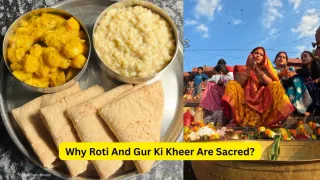
The second day of Chhath Puja, also known as Kharna, is being observed on 14th November. On this day, devotees break their day-long fast by offering Gur ki kheer and roti to the Sun God and Chhaithi Maiya.
Gur (jaggery) symbolises purity and health, while whole wheat Roti represents life and earth. Consuming this prasad marks the beginning of the intense 36-hour waterless (Nirjala) fast.
Let's understand what kharna is, and why roti and gur ki kheer are consumed to begin the waterless fast of 36 hours in Chhath Puja.
What Is Kharna In Chhath Puja?
The word 'Kharna' means 'purification.' While Nahay Khay cleanses the external body and house, Kharna is dedicated to internal cleansing of the mind, body, and soul.
On this day, the Vratis observe a nirjala fast from morning till evening. They break this fast after consuming the prasad offered to the Sun God (Surya Dev) and Chhathi Maiya, which they eat in total silence.
Following this meal, the strict 36-hour waterless fast officially starts, which concludes on the morning of Day 4 (Usha Arghya).
Spiritual And Ayurvedic Significance Behind Preparing Roti And Gur Ki Kheer
Every ingredient of the Kharna prasad holds immense spiritual and practical significance.
1. Gur Ki Kheer (Jaggery Rice Pudding): It is the most important offering that is made using gur, milk and arwa chawal. In Bihar, Jharkhand, and eastern Uttar Pradesh, it is also called Rasiyaav. The gur used for making kheer represents warmth, purity, and natural energy, and arwa chawal (raw rice) represents purity, while milk symbolises prosperity, nourishing the body ahead of the long fast.
2. Roti (Whole Wheat Flatbread): Wheat flour is used to make rotis, which are often smeared with pure desi ghee. The ghee provides necessary healthy fat that helps Vratis have energy throughout the 36-hour waterless fast.
3. Balances The Doshas: Chhath Puja falls during the seasonal transition into winter. The combination of jaggery, ghee, and wheat stabilises the body’s Vata and Kapha doshas, providing enough glycogen to the body and heat that prevents dehydration during the fast.
In Bihar, Jharkhand, and eastern Uttar Pradesh, it is also called Rasiyaav (Image: Pexels)
ALSO READ: Chhath Puja 2026 Date: When Is Nahay Khay, Kharna, Sandhya Arghya and Usha Arghya?
Rules For Preparing Kharna Prasad
There are some rules that every Vratis needs to follow while preparing Kharna prasad:
1. The prasad must ideally be cooked on a brand-new earthen stove using dried mango wood as fuel.
2. Only brass, copper, or brand-new earthen pots are used for making the prasad. Stainless steel or previously used cooking pots should be avoided.
3. One of the important traditions associated with Kharna is maintaining complete silence while consuming the prasad. According to beliefs, Vratis should sit in complete silence and then consume the prasad. If any noise disturbs the Vrati while eating, they must immediately stop eating their prasad and begin their 36-hour-long waterless fast.
4. After the Vrati finishes eating, only then is the prasad distributed to family members and neighbours.
According to beliefs, Vratis should sit in complete silence and then consume the prasad (Image: Pexels)
ALSO READ: The Cosmic Story Of Chhathi Maiya: Why Is She Worshipped Alongside The Sun God?
Preparing Gur ki kheer and roti on Kharna and consuming it after sunset marks the beginning of a 36-hour waterless fast.
FAQs
1. Can salt be used for making Kharna prasad?
No. Salt is not allowed while making Kharna prasad to maintain sattvic purity.
2. What happens if the Vrati is disturbed while eating Kharna Prasad?
According to tradition, if the devotee hears a sudden loud noise or gets distracted, they must immediately wash their hands and end the meal.
3. Can we use white sugar instead of jaggery for Kharna Kheer?
No. Traditionally, Chhath rules prohibit the use of white sugar for Kharna Prasad.