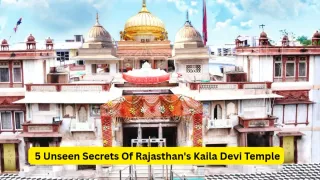
A large number of devotees travel to Rajasthan every year to visit Kaila Devi Temple. This shrine is one of the most revered Shakti Peeths and is dedicated to Goddess Kaila. The temple is believed to be the site where the goddess's hair fell.
Goddess Kaila Devi is regarded as the family deity of Karauli's Yaduvanshi rulers, including Maharaja Gopal Singh. The goddess is also associated with Yogmaya, a divine cosmic energy connected with Lord Vishnu in Hindu mythology.
Here are five interesting facts about this revered temple that make it an important part of Rajasthan's spiritual heritage.
1. The Presence Of Two Deities: Goddess Kaila And Goddess Chamunda
Most tourists think it’s just one shrine. However, the inner sanctum actually has two idols installed together, slightly inclined toward each other. Kaila Devi is an incarnation of Mahamaya or Yogmaya; the child who slipped from Kansa’s hands sits on the left, while Chamunda Devi sits on the right. According to the local legend, the neck of the idol of Maa Kaila Devi remains slightly tilted so that she can listen to her devotees' whispers.
2. The 'Languriya' Cult Culture: Why Hanuman Is Central Here
It is said that you can't understand Kaila Devi without understanding Languriya. Devotees treat Lord Hanuman not just as a deity here, but as the playful, protective child or guardian referred to as Languriya of Kaila Devi. Devotees sing Languriya Geet during the Chaitra Mela to show their reverence towards the deity.
Kaila Devi is an incarnation of Mahamaya or Yogmaya (Image: Fcaebook/KailaDeviTemple)
3. The Unbroken 'Kanak-Dandoti' Ritual
One of the most interesting rituals that is performed in Kaila Devi Temple is Kanak-Dandoti. In this, devotees lie flat on the ground and move forward by prostrating repeatedly. Some pilgrims travel several kilometres this way as a sign of deep faith. Through this act as symbols of surrender, gratitude and wishes fulfilled through the Goddess's blessings.
4. The Royal Yaduvanshi Protection And The Unshakeable Foundation
Kaila Devi Temple shares a connection with the royal family of Karauli, particularly the Yaduvanshi (Jadaun) rulers, who revered Goddess Kaila Devi as their Kuldevi (ancestral family deity).
One of the most prominent contributions came from Maharaja Gopal Singh, who laid the foundation of the temple in 1723 and established the idol of Chamunda Devi alongside Kaila Devi. Successive rulers continued to contribute to the shrine's development, adding facilities for pilgrims and enhancing its architectural beauty.
ALSO READ: Thiruparankundram Deepam Row Explained: How A Temple Lamp Became Political Flashpoint In Tamil Nadu
5. Mythological Connections Associated With Kaila Devi Temple
According to the popular legend surrounding the birth of Lord Krishna, Yogmaya was born as the daughter of Nanda and Yashoda in Gokul. When Vasudeva brought the newborn Krishna to Gokul to protect him from King Kansa, he exchanged the babies, taking Yogmaya to Mathura in place of Krishna.
Kaila Devi Temple shares a connection with the royal family of Karauli (Image: Facebook/ mandirkeladevi)
ALSO READ: Why Do Devotees Give Up Their Hair At Tirupati? The Connection Between Faith, Ego And Surrender
When Kansa attempted to kill the newborn girl, she slipped from his hands, revealed her divine form and warned him about his impending downfall. At Kaila Devi Temple, devotees worship Goddess Kaila Devi as an incarnation of Yogmaya. This belief adds a significant mythological dimension to the shrine, which is also revered as the Kuldevi temple of Karauli
FAQs
1. What is the best time to visit the Kaila Devi Temple?
The best time to visit the Kaila Devi Temple is during the Navratri festival, which is celebrated twice a year, in March-April and September-October.
2. What are the required samagri for worship at the Kaila Devi Temple?
The required samagri for worship at the Kaila Devi Temple includes prasad (offerings) for the goddess, fruits and flowers for worship, and coconuts and other items for rituals.
3. What are the step-by-step vidhi for worship at the Kaila Devi Temple?
The step-by-step vidhi for worship at the Kaila Devi Temple includes taking a dip in the nearby river or water body, changing into clean clothes, offering prayers and worship to the goddess, and receiving prasad and blessings from the priest.