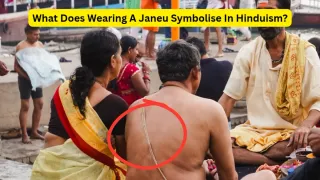
Have you ever noticed why some Hindu men wear a white thread across their left shoulder? This thread is called Janeu, also known as Yajnopavita, which holds immense spiritual significance in Hinduism. It symbolises self-discipline, spiritual rebirth and purity.
Janeu is bestowed on a young boy during the sacred Upanayana Sanskaar (initiation ceremony) and is described in the Vedas as the second birth.
Let's understand why Janeu is tied in Hindu tradition and what it symbolises.
Spiritual Significance Of Wearing Janeu
Janeu is more than a white thread. It symbolises rebirth and moral responsibility. The three knots tied in Janeu also carry deep meaning. Here's how:
1. Second Birth
When a boy receives a Janeu during an Upanayana Sanskaar, he is considered Dvija (twice-born). The first birth is physical birth from the mother's womb, and the second is entry into the world of knowledge and spiritual responsibility under the guidance of a Guru.
2. Meaning Of The Three Strands
The basic Janeu has three cotton strands that are tied together. These three strands represent the debts of life:
1. To the sages or gurus for seeking knowledge, learning, and sharing truth.
2. To ancestors for maintaining lineage traditions and raising a righteous family.
3. To the divine for protecting creation.
The three strands also represent the three trinities: Lord Brahma, Lord Vishnu and Lord Shiva and are also seen as the symbol of purity of thought, speech, and action.
The basic Janeu has three cotton strands that are tied together (Image: Pexels)
3. The Sacred Knot(Brahma Granthi)
The three main strands are tied together by a central knot known as the Brahma Granthi (The Knot of Brahma). This knot symbolises the ultimate reality that binds all of creation together.
In Tantra and Yoga, the knot symbolises control over material instincts and attachments, allowing spiritual energy (kundalini) to rise.
4. The 9 Finer Threads (Navatantu)
Inside each of the 3 main strands, there are 9 finer threads. These 9 threads represent the Navadvaras, the nine gates or openings of the human body. Wearing the Janeu guards these 9 openings, ensuring that what enters the body and leaves should remain pure.
Why Does The Number Of Strands Change?
The composition of the Janeu changes depending on which stage of life he is:
Stage of Life | Number of Strands | Meaning |
Unmarried (Student / Brahmachari) | 3 Strands | Focus on study, self-discipline, and inner growth. |
Married (Householder / Grihastha) | 6 Strands (Two sets of 3) | 3 strands for oneself + 3 strands representing the spouse and shared household duties. |
Renunciate (Vanaprastha / Sannyasa) | 9 Strands or None | Symbolises universal responsibility, or the complete transcendence of ritual obligations. |
ALSO READ: Why Do Devotees Offer Betel Leaves And Betel Nuts In Puja? Know Their Spiritual Significance
How To Wear A Janeu?
The Janeu is traditionally worn in different ways depending on the religious ceremony being performed. These methods are described in various Vedic traditions and Grihya Sutras.
Style | How It Is Worn | Traditionally Used For |
Upavita | Over the left shoulder and under the right arm | Daily worship, yajna, temple rituals, and other auspicious ceremonies |
Nivita | Around the neck like a garland (mala) | Certain forms of study, meditation, and specific traditional practices |
Prachinavita | Over the right shoulder and under the left arm | Rituals performed for ancestors, such as Shraddha and Pind Daan |
ALSO READ: Finding Hair In Your Food Repeatedly? Is It A Sign Of Bad Luck Or Something More?
Thus, wearing a janeu represents a lifelong commitment to knowledge, discipline, humility, and righteous living. When a person understands its true meaning, it serves as a constant reminder for the wearer that real spirituality comes from one’s thoughts, actions, and character.
FAQs
1. Can anyone receive the Yajnopavita?
The customs regarding who undergoes Upanayan Sanskar and receives the sacred thread differ among Hindu communities, sampradayas, and regional traditions. These practices have evolved and may vary from one family tradition to another.
2. What is the significance of the three strands of the Yajnopavita?
The three sacred strands represent the Three Debts that every individual is expected to honour throughout life.
3. Why is the Yajnopavita worn in Hinduism?
Traditionally received during the Upanayan Sanskar, it is worn as a reminder of one’s spiritual and moral responsibilities.