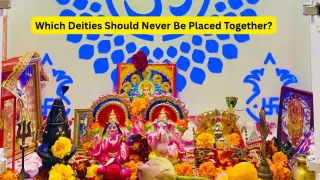
In a Hindu household, a home temple is one of the most sacred places. The idols in the puja room are believed to bring peace, positive vibes, and spiritual growth.
However, according to Vastu Shastra and traditional Hindu scriptures, placing certain deity idols together or grouping specific representations incorrectly can disrupt the energy flow.
If you are setting up or rearranging your home mandir, here are the traditional rules for which Hindu gods and goddesses should not be placed together.
Why Should Certain Idols Never Be Placed Together?
The idol represents a divine aspect of the cosmos. Traditional beliefs suggest that their individual energies (tamasa, rajasa, and sattva) require specific alignments. If they are placed according to these energies, then instead of bringing harmony to the household, they can disrupt the flow of energy.
So, here are a few idols that should never be placed together:
1. Shani Dev With Other Deities
Lord Shani should never be placed with other deities in the home temple. It is believed that Shani Dev’s direct gaze carries intense energy that governs justice and penance, which is not ideal for the home atmosphere. Instead, worship him in the outside temple.
2. Violent Or Aggressive Forms Beside Calm Deities
Do not place fierce, aggressive forms of deities such as Lord Bhairava, Goddess Kali, Lord Nataraja, or Lord Narasimha with peace-loving deities like Goddess Lakshmi-Lord Vishnu or Lord Krishna. The energetic vibrations they produce are very intense, which is not suitable for homes.
This fiery energy is meant for strict ascetic rituals, not everyday domestic worship. So it is advised to place the idol usually in the Abhaya Mudra for prosperity and peace
3. Never Keep Radha-Krishna Idol Together With Rukmini
Devotees should never place an idol of Radha-Krishna directly adjacent to Krishna with Rukmini on the same puja space.
According to Hindu traditions, worship takes place according to the divine relationship and energy. Mixing these depictions on one shelf creates symbolic conflict in devotional practice. And in this case, it is between dharma and bhakti.
Devotees should never place an idol of Radha-Krishna directly adjacent to Krishna with Rukmini (Image: Pexels)
4. Never Keep The Idols Of The Same Deity Together
In Vastu Shastra, numerical symmetry holds immense importance. Placing too many idols of the same god in one home mandir is believed to create conflicting spiritual vibrations.
That is why you must have seen that two Shivlings are never kept together, as they neutralise subtle energy balances.
Correct Placement: How To Position Goddess Lakshmi And Lord Ganesha Idols
Most often, people make mistakes while placing the idols of Lord Ganesha and Goddess Lakshmi in the home mandir. According to Vastu, place Goddess Lakshmi on the left and Lord Ganesha on the right side.
Essential Do's And Don'ts For Home Mandir Idols
Category | Do This | Avoid This |
Idol Height | Keep idols under 7–9 inches for home temples | Avoid massive temple-sized idols |
Damaged Idols | If idols are cracked or chipped, immerse them respectfully | Never keep cracked or broken idols |
Direction | Idols should face North or East | Facing West or South is generally discouraged |
Facing Each Other | Place idols facing the room or devotees | Never place two idols directly facing each other |
So, these are a few idols and certain rules one must follow while setting up the home mandir.
FAQs
1. Can we keep Rahu and Ketu in a home temple?
No. Rahu, Ketu, or Rahu-Ketu Yantras should not be kept in domestic mandirs as they are shadow planets and keeping them in the puja room requires strict astrological guidance.
2. What should I do if I have broken idols in my mandir?
Cracked or damaged idols are called Khandit murti should be respectfully removed, wrapped in a clean cloth, and immersed in a flowing river or buried under a sacred tree.