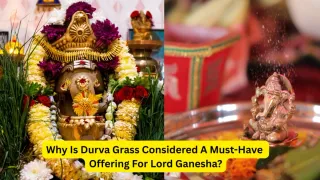
Lord Ganesha has arrived in the homes of his devotees for at least 10 days. Every year, the devotees celebrate his homecoming with great enthusiasm on Ganesh Chaturthi.
During his puja, modak, flowers, and durva grass (Bermuda grass) are offered. It may seem like a simple grass, but it's considered a symbol of devotion, humility, and dedication.
Let's understand in detail the spiritual significance of durva grass and the mythological story behind it.
Why Is Durva Grass Offered To Lord Ganesha?
The word durva is derived from the words ‘duhu ’, which means far away, and ‘avam’ means ‘closer’. Thus, in a way, it means devotees are coming closer to Lord Ganesha.
Along with this, the durva consists of three blades, which represent the three principles of primal Shiva, primal Shakti and primal Ganesha. Durva is said to have the ability to attract the Lord Ganesha principle, which is why it is an important offering to Lord Ganesha.
What Is The Mythological Story Behind Offering Durva To Ganesha?
According to the Bhavishya Purana, the demon named Analasura (meaning fire) had caused havoc in the universe. Everywhere he went, things burned. The Gods tried to stop him but failed. Seeing no other option, they went to Lord Ganesha to seek his help.
Lord Ganesha then took a gigantic form, and instead of fighting him, he swallowed him. However, because of the fire demon inside him, his body started heating up. The gods applied sandalwood paste, offered lotus flowers and even poured cold water to soothe him. However, nothing worked.
Then a group of 88,000 sages led by Sage Kashyap performed an archana by offering 21 blades of fresh Durva grass to Lord Ganesha. As soon as it was offered to Lord Ganesha, it gave him instant relief due to its cooling effect. Lord Ganesha then declared that whoever offered him the durva grass would have his immense blessings.
Durva is said to have the ability to attract the Lord Ganesha principle (Image: Gemini AI)
Why Are 21 Blades Of Durva Grass Offered To Lord Ganesha?
Lord Ganesha is always offered 21 blades of durva grass. The logic behind 21 is that it represents the five senses of knowledge, five senses of action, five vital forces, five tanmatras and the mind. If we add then it comes to 21. By offering these 21 Durva grasses, the devotee is acknowledging his existence and surrendering their entire existence at his feet.
ALSO READ: Why Should You Not See The Moon On Ganesh Chaturthi? Know The Story Of Lord Ganesha’s Curse
Connection With Ayurveda
According to Ayurveda, durva juice reduces the burning sensation in the body and provides an instant cooling effect.
How To Offer Durva Grass To Lord Ganesha During Puja?
The right way to offer durva grass to Lord Ganesha during puja is:
- Before Ganesha Puja, a devotee should always bathe and wear clean clothes.
- Durva grass should always be green, fresh, and separated from its roots.
- The durva stalks offered should have leaves in odd numbers like 3, 5 or 7 because of its association with Shakti.
- It is considered appropriate to offer it to God only after washing it with clean water.
- While offering Durva, one should chant the mantra 'Om Gan Ganpataye Namah.'
- After this, devotees can offer modaks, laddus, fruits, or any other sattvik offerings.
While offering Durva, one should chant the mantra 'Om Gan Ganpataye Namah' (Image: Pexels)
ALSO READ: Why Is Lord Ganesha Called Ekadanta? The Story Behind His Broken Tusk
Now you must know why durva grass is considered so significant in Lord Ganesha worship.
FAQs
1. Is there a specific number of Durva blades to offer to Lord Ganesha?
Yes, 21 Durva blades are offered to Lord Ganesha during his puja.
2. Which mantra is chanted while offering Durva?
While offering Durva, the mantra "Om Gam Ganapataye Namah" can be chanted.