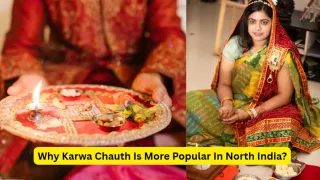
Karwa Chauth is a one-day festival that holds immense spiritual significance for Hindus. On this day, married women observe a fast from sunrise to moonrise for the long and healthy life of their husbands.
If you look at the rituals of Karwa Chauth, like the Sargi ritual, the glowing sieves, and the moonlit offering, it feels like a pan-Indian festival.
However, Karwa Chauth has been mainly celebrated in North Indian states like Punjab, Haryana, Rajasthan, Uttar Pradesh, and Himachal Pradesh for centuries, unlike in South India. But why?
The answer lies in the agricultural cycles, military history and regional mythologies.
1. Historical And Military Connection
North India faced more foreign invasions and military campaigns. Men serving in the army or traders often had to leave for days. To pray for their husbands' safety and long life, women during this time started observing strict fasts.
The Karwa Chauth timing coincides with their departure. People started practising this ritual as a protective shield.
However, South India, protected by geographical barriers like the Vindhya and Satpura ranges, experienced different historical and military attacks, leading to distinct localised traditions.
People started practising this ritual, thinking of it as a protective shield (Image: Pexels)
2. Agricultural Cycles: The Earthen Pot Connection
In Karwa Chauth, 'Karwa' means a pot, and ‘Chauth’ is the fourth day after the full moon in the month of Kartik.
In North India, the Rabi crop is sown during Karwa Chauth. Farmers stored wheat seeds in these heavy Karwas. Thus, praying over the Karwa served two purposes. It helped in invoking blessings for the husband's long life and, secondly, ensured a good wheat harvest.
South India follows a completely different agricultural calendar, where rice is cultivated instead of wheat during Pongal or Makar Sankranti.
ALSO READ: Karwa Chauth 2026: 5 Ritual Mistakes Women Should Avoid During The Vrat
3. South India Has Its Own Festivals
Many times, people think that South Indian women do not observe the fast for their husbands' long life just because they do not celebrate Karwa Chauth.
However, they have different festivals with the same intention. In Tamil Nadu, people celebrate Karadayan Nombu in devotion to Savitri (who saved her husband Satyavan from the God of Death, Yama).
On this day, married women fast, tie a sacred yellow thread, and offer steamed rice cakes with butter.
In Andhra Pradesh, Telangana, and Tamil Nadu, people celebrate Varalakshmi Vratam, a festival dedicated to Goddess Lakshmi. On this day, married women pray for the health, wealth, and longevity of their entire family, including their spouses.
In Karnataka, women observe Gowri Habba, a day before Ganesh Chaturthi, worshipping Goddess Gowri (Parvati) for marital bliss and harmony.
In Tamil Nadu, people celebrate Karadayan Nombu in devotion to Savitri (Image: Pexels)
ALSO READ: Karwa Chauth 2026: Can Unmarried Girls Keep The Fast For Their Future Husband? Know The Rituals
Karwa Chauth is more celebrated in North India because of the region's geography, military past, and wheat-sowing cycles. South India also has marital fasts, like Karadayan Nombu and Varalakshmi Vratam, which express a similar intention.
FAQs
1. Are there any similar fasting traditions for married women in South India?
Yes, Savitri Vratam and Varalakshmi Vratam are some similar fasting traditions that involve fasting for a spouse's well-being.
2. How have Bollywood and media influenced Karwa Chauth's perception?
During the late 1990s and early 2000s, Bollywood and media reimagined Karwa Chauth as the ultimate cinematic expression of romance. What was once a localised, North Indian ritual became a glamorous, globally recognised celebration adopted by urban populations across India.