Racism cases have evolved significantly in football in recent years. As a matter of fact, FIFA has implemented a universal anti-racism protocol to protect players, coaches and even match officials from racist abuse.
The Argentina vs Egypt Round of 16 clash in the FIFA World Cup 2026 also witnessed an incident involving the anti-racism gesture, which has now sparked widespread debate. Argentina grabbed a fascinating 3-2 win against Egypt in a match of controversies.
Egypt national football team head coach Hossam Hassan drew significant attention after directing a gesture toward the officiating crew during his side's FIFA World Cup Round of 16 defeat to Argentina.
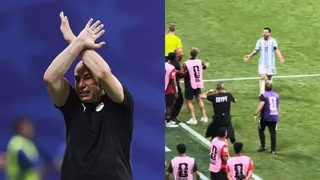
Moments later, Lionel Messi was seen in a heated exchange with the Egyptian manager, with the incident quickly going viral across social media. While many fans have linked the two moments together, there has been no official confirmation that Hassan's gesture was directed at the Argentina captain, making it one of the biggest talking points from an already controversial encounter.
WATCH: Lionel Messi's Heated Exchange With Hossam Hassan Goes Viral
The incident unfolded during the closing stages of Argentina's controversial Round of 16 victory. As tempers flared on the sidelines, cameras caught Lionel Messi exchanging words with Hossam Hassan before the Egypt coach immediately crossed both of his arms to form an "X".
The clip has since gone viral across social media, with fans debating whether Hassan was accusing someone of racist behaviour or attempting to alert the referee to an incident that had occurred earlier in the match.
What exactly was said during the exchange remains unknown. No official audio has emerged, while neither Messi nor Hassan has commented publicly on the confrontation.
Egypt Coach's 'X' Gesture Explained
Unlike many celebrations or hand gestures seen on a football pitch, the crossed-arm "X" has a very specific meaning under FIFA regulations.
Ahead of the FIFA World Cup 2026, FIFA formally introduced the universal anti-racism gesture across all competitions. Players, coaches and team officials are instructed to cross both arms into an "X" if they believe racist abuse has taken place.
The signal is designed to immediately alert the referee, who can then activate FIFA's three-step anti-racism protocol.
The protocol allows match officials to:
- Stop the match and issue a public warning.
- Suspend play and send both teams to the dressing rooms if the abuse continues.
- Abandon the match entirely if the situation does not improve.
The initiative was introduced to create a universally recognised signal, ensuring allegations of racist abuse receive immediate attention regardless of the competition or language barriers.
Why Was Hossam Hassan Shown A Yellow Card?
One of the biggest talking points is that referee François Letexier did not appear to initiate the anti-racism protocol after Hassan made the gesture.
Instead, the Egypt coach was booked for dissent as he continued protesting several refereeing decisions. During his post-match press conference, Hassan launched a scathing attack on the officiating, claiming Egypt had been denied key decisions throughout the match. “ Life is unfair. The world is unfair. OK, but why isn't there any fairness in sports? I'm not convinced by this outcome and by the way things unfolded in this match," he said.
Despite the viral speculation, Hassan did not state in his post-match remarks that Messi had racially abused him or that the "X" gesture was specifically directed at the Argentina captain.
Was The Gesture Directed At Lionel Messi?
The viral footage has led many social media users to conclude that Hassan was accusing Messi after the two exchanged words. However, there is currently no evidence to support that claim.
Neither FIFA, the match officials, nor the Egypt Football Association have released any statement confirming that a racism complaint was filed during the match. Likewise, there has been no disciplinary announcement involving Messi.
It is therefore impossible to conclude, based on the available evidence, whether the gesture referred to Messi, another individual, alleged abuse from the crowd, or was simply an attempt to draw the referee's attention to an incident that occurred elsewhere.
ALSO READ: Egypt Star Alleges FIFA World Cup 2026 Is 'Fixed' After Argentina Defeat, Sparks Massive Controversy
A Match Surrounded By Controversy
The Messi-Hassan confrontation is only the latest controversy to emerge from an extraordinary Round of 16 encounter.
The match had already generated global debate after Messi missed another World Cup penalty, several VAR decisions went against Egypt, and Hassan questioned the officiating after the final whistle. Egypt defender Mohamed Abdelmonem also alleged that the tournament was "fixed," further intensifying scrutiny surrounding the contest.
Off the pitch, videos also surfaced showing a section of Argentina supporters allegedly throwing beer cans and abusing Egypt fans following the final whistle.
With so many points packed into one knockout fixture, Argentina's dramatic comeback has almost been overshadowed by the controversies that continue to dominate headlines long after the final whistle.